
More on Mindsets
Introduction
Changes in mindsets are required to achieve a successful change, ie successful change is
"...80 - 100% dependent on people changing how they think and work..."
Prosci as quoted by Leslie Ellis, 2023
Examples of old mindsets that need to change and some ways of doing it:
| No. | Old Mindsets*i | New Mindsets Required | Some Approaches to Develop a New Mindsets *ii |
|---|---|---|---|
| 1 | Implementing change (a reactive approach, ie reacting to what has happened, etc; status quo thinking dominates) |
Anticipating change (a proactive approach; designing, planning, etc; challenging the status quo; understanding the impact of trends, etc; understanding where change comes from and what changes are needed) |
- ask to get involved early in the change efforts, ie at the planning stage, rather than at implementation - learn how to create a change strategy and reinvention strategies, ie explore ways to be more creative and innovative - have an experienced mentor/coach involved in change initiative - raise concerns or issues & collaborate to mitigate them, ie have you thought about what will happen when..... |
| 2 | Specialising in one framework/ methodology (one-size-fits-all, ie what works in one situation is applicable to other situations, etc) |
Diverse approaches and disciplines (expand awareness, capabilities, etc; realise the uniqueness of every situation; agile, flexible and diverse in approach) |
- study and investigate alternative frameworks, methodologies, disciplines (human behaviour, etc), techniques (coaching,facilitation, mediation, negotiations, negotiations, etc), etc that could be relevant- increase collaboration (including engagement); actively seek others' points of view- partner with other experts in supporting disciplines and shadow them |
| 3 | Focus on output ('just get it done' mentality, etc) |
Deliver results (need to deliver what the organisation wants; system/processit thinking, etc) |
- clarify the why (why are we doing this?; what are we trying to achieve?) - identify the end-to-end process steps for each change activity planned, eg meeting, surveys, workshop, webinar, etc so that the results expected are achieved - use systems thinking to understand how everything integrates and are interdependent - continually revisit the desired outcomes of the change to stay aligned with the purpose and desired results; speak the same language - less focus on decision-making based around timelines and budget constraints, etc, and more decision-making around results |
| 4 | Always done this way; no time for that(status quo thinking; timeline and budgets dominate; everybody too busy, ie don't have time to address the required change, etc) |
Doing change right the first time (focus on results, ie what is the best approach to achieve desired results, etc) |
- avoid making decisions based on timeline and budget constraints (see above); minimise unnecessary rework - proactive approach to designing and gaining alignment as a way to handle future issues, emerging information and challenges, ie try to anticipate what could happen, and how to handle it, if it does happen - increased stakeholder engagement (get them involved as early as possible in the change process; use them as reality checks, ie how to handle some of the challenges around change) |
| 5 | Experts in WHAT to change (develop specialist skills in the content of the change, eg technical, operations, logistics, etc) |
Experts in HOW to change (not technical functional experts; need knowledge on how to create systems, frameworks, techniques, etc for change; you are more a generalist than a specialist) |
- clarify and understand everyone's roles and responsibilities (including yours) to increase effectiveness- engage your mentor/coach- seek out training in the change process area |
| 6 | Expert on everything (assume that you have the answers/ solutions, etc on all the challenges |
Generalist(have enough knowledge on many topics, etc so that you can ask the right questions, etc and/or have access to specialist expertise, when required) |
- ensure that you have a basic understanding on the most relevant topics involved- seek out training where there are gaps in your required knowledge- have access to specialist expertise, when required |
(main source: Leslie Ellis, 2023)
Notes
i) need to change mindset from 'old' to 'new'
ii) the usefulness of the different approaches will depend upon the situation you are in
How to change your mindset
NB The way you think and talk usually drives how you behave.
i) be aware of your limiting beliefs and fears that are obstacles to your mindset change (see above table of old mindsets; record your beliefs and fears that are limiting the shift in your mindset required to handle change)
ii) determine what's real (how authentic are they, ie based on experience, learnings, others' influence on you, etc; identify what's real and what is not real, ie made up, invented, etc)
iii) decide whether you going to change (usually this is based on responses to i) & ii))
iv) change your language (talking is a behaviour; words will drive your behaviour, eg talk more about results than outputs, the 'how' of change rather than the 'what' - see above table)
v) take additional supporting actions (
"...no quick fixes here. It takes commitment, practice and therefore, time to shift your mindset...... you can start practising......now..."
Leslie Ellis, 2023)
NB this can push you out of your zone of comfort.
Summary
"...Mindset is more than half the journey to advancing your change of leadership capabilities. Mindset influences our approach to problem-solving, communications, collaboration, and our ability to navigate the ongoing complexities of organisational change for yourself and others..."
Leslie Ellis, 2023
Mindset changes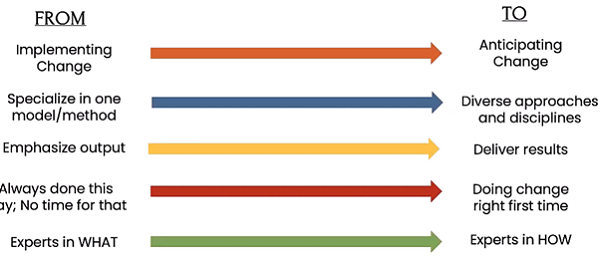
(source: Leslie Ellis, 2023)