
More Details On The 8 Productive Tensions Of Innovation - 7. Promoting Your Brand Or Solving Someone Else's Problem
Q - Do you spend money on promoting your own brand or solving someone's problem?
Most customers do not buy a brand: they buy a product and/or service to solve a particular problem, ie 'job to be done'. In addition to the functional dimensions, there are social and emotional dimensions.
There are 3 steps involved in creating a product and/or service to handle the job to be done:
i) understanding the job (its functional, social and emotional dimensions; solving customers' problems requires seeing things from their point of view)
ii) defining the experience is required to do that job (it is important to know what experiences are needed for a given product and/or service to satisfy the customer, ie ask
"...Do the accompanying experiences help customers make progress they want to make..."
Christopher Bingham et al, 2022a)
iii) developing processes that enable it to happen (is your organisational structure able to integrate all the processes (internal and external) required to get the job done? Consider retail strategy, customer relationships, inventory management, talent acquisition, etc;)
Diagram - product v. purpose (how will we create a unique brand advantage and sustain it over time)
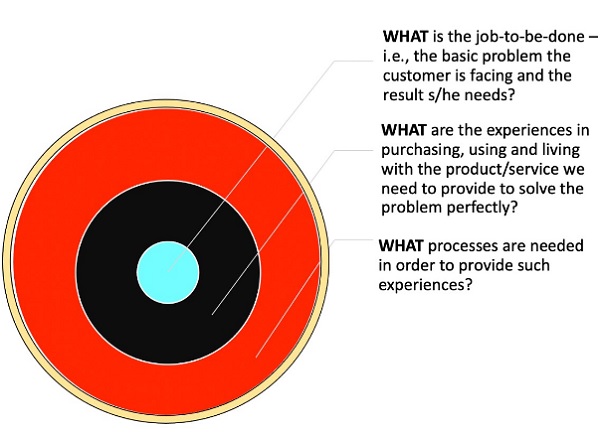
(source: Christopher Bingham et al, 2022)
An example is IKEA
"...Adopted a big-box retail format to stock large amounts of inventory and to showcase furnishings for an entire home. Many locations also include on-site dining and daycare, reinforcing the company's status as one-stop shop. Flat-pack furniture ensures that most items can be easily carted home in most vehicles......recognise that people want to furnish their homes quickly, They don't want to make multiple trips. They want to bring items home the same day and set up everything with minimal fuss. That's why IKEA provides a one-stop shop where customers can buy everything they need for every room in their house.......IKEA also offers same-day delivery services and products that are relatively easy to assemble with a single tool..."
Christopher Bingham et al, 2022a
Branding and marketing
Most new brands fail. The reason for this is too much focus on the brand identity image, ie advertising, promotion, etc rather than purpose, ie to help customers to do a particular job.
Three ways to integrate branding and marketing product development
i) identify how product and/or service can meet customers' needs, ie functional, emotional and social. For example, driving a car involves social and emotional satisfaction as well as the functional ones.
ii) provide excellent customer service, ie ensure that customers' experience in purchasing and using product and/or service is faultless
iii) develop and align processes to make brand synonymous with the job to be done (integrate all processes so they work as one)
Purpose brand (is linked to a particular job to be done
"...becoming virtually synonymous with the job in prospective clients' minds......Well-designed purpose brand functions like a compass of both customers and company staff. It guides customers to the products that will do the job they need done......Guides the organisation's product designers and marketers as they develop new and improved offerings...... creates its own roadmap for future......creates enormous opportunities for differentiation, premier price and growth..."
Christopher Bingham et al, 2022a
Some examples include Google (information search), Zoom (Virtual meetings) , Xerox (Photocopying), Airbnb (accommodation), Uber (ridesharing), etc.
A purpose brand can often command a premium price.
Extending a purpose brand to new products, ie leverage the purpose brand to endorse and legitimise other products that address similar jobs
"...introduce a new product under the umbrella of an existing brand logically extends the brand. This involves creating a two-tier brand architecture: the original brand becomes......the endorser lending legitimacy to the new product..."
Christopher Bingham et al, 2022a
Some questions around this include how far can this be extended, ie are there no limits to the number of new products a company can introduce and legitimise under purpose brand? This leverage can save a lot of money.
Ways of capitalising on purpose-brand extensions and minimising risk
i) extend brand to new products that can do the same job. For example, Sony's Walkman original product's successful branding (portal tape player) was extended to a new product (a portable CD player) in the pre-MP3 era as the fundamental job was the same ie playing recorded music.
ii) using an existing brand to endorse a product that does a different job (this requires creation of a new purpose brand, ie sub-brand; the new product can benefit from the legitimacy of the endorser brand as long as it fulfils its own purpose)
iii) use two-word brand architecture (this distinguishes endorser brand from the newly-created purpose brand; this is most effective when moving downmarket to tap into disruptive growth opportunities, eg Uber ridesharing to Uber eats)
Summary
Building and extending a purpose brain
| "...Instead of doing this... |
Do this.... |
And get this result.... |
| Overly focusing on brand identity and image | Think harder about perfecting brand's purpose: helping address the job to be done, the basic problem customers are facing and the solution they crave | Valuable products and services that customers are willing to bring into their lives to make progress on a particular task |
| Looking for jobs to be done using traditional market research or segmentation categories, such as gender, age, and income levels | Watch what customers do, and get explanations for what people hired instead | A coherent picture of the progress those customers are trying to make in their lives |
| Assuming that customers make purchasing decisions on the basis of certain set product features | Find out what collateral experiences (social, emotional, functional, etc) should accompany a product to perfectly nail the job to be done | Enormous opportunities for differentiation, premier pricing, and growth |
| Spending money lavishly early on for advertising, marketing, and media |
Design organisational structures to reliably provide the experiences that customers crave |
A roadmap for the future |
| Extending the brand to target jobs far afield from its purpose | Extend the brand to new products that can be hired to do the same job |
No loss of brand's meaning to consumers and no dilution |
| Standing with the existing brand |
Use the existing brand to endorse the quality of a product that does a different job, then create a new purpose brand around that product |
New-Brand benefits attributed to the legitimacy of the endorser brand..." (source: Christopher Bingham et al, 2022a) |
Despite a good success rate, purpose brands are rare. This may be due to problems with market segmentation (see below) and because brands are directly linked to a particular need in a specific market, ie exclusiveness. There is a temptation, eg desire for growth, to expand to other markets that could erode its exclusive image.
The market segmentation by demographics or psychographics like gender, age, income level, etc are not necessarily accurate indicators of what people's needs are.
"...an unwavering focus on the jobs that customers are trying to accomplish promises greatly improved odds of success in the new-product development and brand building..."
Christopher Bingham et al, 2022a
Need to focus more on the brand's purpose than identity and image.
With technological advances (including sophisticated analysis tools) you know more about your customers than ever before. However, there is still much misunderstanding to why people buy and/or don't buy.