
More Details On The 8 Productive Tensions Of Innovation - 8. Keeping Stakeholders On Side During The Change
Q - How do you keep supporters on board when you inevitably need to change direction?
Communications is the key to keeping stakeholders on side.
Ways to keep stakeholders on side
- develop a compelling general purpose/vision (rather than communicating specific challenges and their solutions; ideally linked with a larger societal objective, like democratised finance, etc; focus on the big picture, big abstract ideas and broad narrative with emotional appeals and minimal detail; later build credibility with detailed plans to meet specific market needs or solve particular problems, including a path to growth and profitability, ie
"...They don't lay out a roadmap; they promise to reach a destination..."
Christopher Bingham et al, 2022a)
Some examples
"...- Microsoft is modernising the workplace
- LinkedIn is connecting the world's professionals to make them more productive and successful
- Patagonia is in business to save the planet..."
Christopher Bingham et al, 2022a
Netflix's stated purpose was offering the best home video viewing for everyone - not offering DVD by mail, which was the company's actual product; its evolution to digital distribution Still warm to its initial purpose)
- any variations/corrections need to still fall under the purpose/vision (maintain consistency, etc
"...the human mind values consistency......(people perceive) inconsistent organisations are less legitimate and their offering less deserving of their support..."
Christopher Bingham et al, 2022a
The key is to revisit and broaden, not change, the pitch; this can be risky, ie will the stakeholders accept it)
- adopt a conciliatory and empathetic attitude to stakeholders who are negatively impacted and/or have a different points of view (generally innovators have to move quickly to catch the fleeting opportunities; with resource restraints and time constraints adding pressure to move quickly; for some stakeholders, changes are unwelcome and they feel alienated, thus need to show empathy and understanding, ie
"...act with common decency..."
Christopher Bingham et al, 2022a
- keep key stakeholders loyal via good communications
The messages to stakeholders need to be honest, helpful and sensitive.
An example is Microsoft's shift to cloud services. It was executed quickly and with humility
"...Microsoft took pains to contextualise and justify the shift as consistent with its overreaching storyline and ambition. Among its many outreach efforts to reconcile audiences to the move was an informative multipart series called Expedition Cloud: a once in a generation paradigm shift......It documented Microsoft's journey, situated the shift within its larger narrative and admitted past difficulties. It called the challenges 'daunting' and acknowledged that the move cloud was a radical departure from its traditional business......the pivot seemed less like a repudiation of the past than a natural evolution of the business..."
Christopher Bingham et al, 2022a
Sometimes organisations have to reinvent themselves as they continue to learn more about customers, business partners and new technologies. Some examples
- Twitter was launched as a podcast directory
- Yelp began as an automated e-mail service
- Wrigley's switch from baking powder to chewing gum
- YouTube started as a dating site
Some stakeholders, like investors, etc will want as much information, detail, etc as possible. Therefor, at the start, innovators need to be careful they don't get too explicit and detailed. Otherwise, when they change course they can have an image problem by appearing to be inconsistent , insincere or overly opportunistic.
In established organisations, sometimes successful, legacy processes and structures can be a liability and extremely difficult to change as stakeholders have a strong attachment to them.
Diagram - consistency v. change (How do we maintain trust and consistent vision amid inevitable adaptation?)
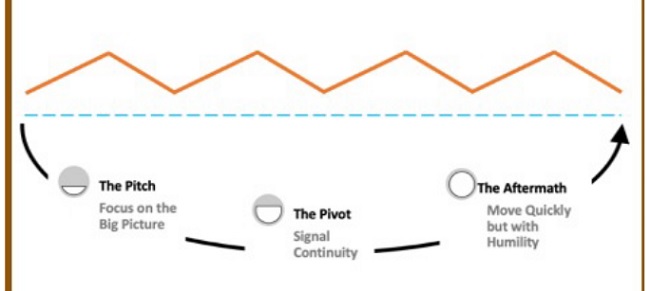
(source: Christopher Bingham et al, 2022)
"...a new initiative needs a good narrative to rally support. But an overly specific narrative can become an albatross, if and when it becomes necessary to change course. Early on, leadership should communicate a compelling but inexplicit mission and avoid being too specific in communications to investors and the new media. If a course correction is needed, leadership focus on consistency with the organisation's original mission. It's often not the pivot itself that causes a venture to stumble but how it is communicated to stakeholders, and whether they feel betrayed or understood..."
Christopher Bingham et al, 2022a
Summary
"...throughout history, great leaders have understood their stories and sense making are especially important during periods of uncertainty. As more industries are upended and as changes in consumer behaviour become more frequent, businesses of all sizes increasingly face a need for strategic reorientation..."
Christopher Bingham et al, 2022a
How to project that consistent vision during inevitable adaptation
| "...Instead of doing this... |
Do this.... |
And get this result.... |
| Launching with a detailed speech that conveys a product concept and a precise path of growth and profitability | Craft broad narratives - big umbrella ambitions that avoid specifying a roadmap in favour of promising to reach a destination | Room to manoeuvre, more enthusiasm and support and more resources |
| Reframing each new business generation as a new goal | Link the new strategic direction to the initial pitch and to larger aims, especially broad societal missions | Maintenance of credibility and stakeholders confidence during the course corrections; face-saving |
| Changing course abruptly, and admitting that you were wrong to do so only when stakeholders react negatively | Express empathy and regret when proactively informing people about changes they may not welcome |
Customers and other stakeholders don't feel abandoned after a major reboot..." (source: Christopher Bingham et al, 2022a) |