
More Details On The 8 Productive Tensions Of Innovation - 6. Framing Innovations Effectively
Q - How do you make new-to-the world innovations comfortably familiar, while still distinct?
Getting the right balance on familiarity and novelty is crucial when introducing innovative products and/or services, ie need to determine when to stress familiarity and when to stress novelty.
"...Individuals' sense of comfort with a new phenomenon and their attraction to the novelty it represents are twin determinants of whether they will venture beyond routine and risk giving it a try......Comfort and attraction combined in the right proportions drive new users' adoption at the individual level; these individual adoption decisions aggregate over time to create more widespread receptivity..."
Christopher Bingham et al, 2022a
People's perceptions on innovations determine whether they are accepted or rejected it. This perception can develop before they encounter the new goods and/or services themselves. It can be based on other people's experiences that they have heard about.
It is usually best when introducing something new to explain its familiarity or similarities with what you are currently doing or using, ie your existing products and/or services. Growing familiarity helps get acceptance for innovation, ie it provides an anchor. It lowers the barriers to entry for new users. At the same time, people's curiosity can be heightened by its novelty. Need to be careful not to downplay novelty as it can suppress the attraction and curiosity necessary to drive trial and adoption.
The classical case study is the introduction of sushi into America. Eating raw fish was perceived as strange, foreign and vaguely repulsive by most Americans in the early 1970s. Using the Californian roll with its conspicuous and familiar ingredients of avocado, cucumber and rice plus a little crabmeat (hidden in the inside of the roll) provided the gateway to sushi in America; soon people felt comfortable eating raw fish as part of sushi; now more than US $ 2 billion worth of sushi is consumed annually in USA.
Framing information as both familiar and novel. Initially emphasise familiarity, eg automobiles were originally called 'horseless carriages', with power generated by automobiles defined as 'horse power', the Internet was initially called the 'information superhighway', etc. This is called context-anchoring. Some more examples include
- payment options in Apple wallet looks like miniature credit cards
- calculator apps simulate physical calculator
- software calendar looks like a desk calendar, etc
"...when introducing a new-to-the-world technological innovation, it is wise to begin emphasising its similarity to existing technological solutions and minimise discussion of what is novel..."
Christopher Bingham et al, 2022a
This is different to the traditional approach of using differentiation and distinctiveness as competitive advantages. This works better in established competitive markets where competition is only about minor changes in features and benefits, and not introducing something new.
Once the new technology is more acceptable, change focus to novelty rather than familiarity. After gaining initial traction, start explaining the uniqueness of the product and/or service in more detail.
Some examples
- 3-D printing (used the word 'printing' to help an organisation understand the technology's basic functionality. Once organisations became familiar with 3-D printing, they increasingly understood its versatility and potential. At this early stage, its novelty was the focus, ie a subset of additive manufacturing used in aerospace, automobile, retail, medical, dental, etc.)
- e-books (used the word 'book' to evoke the concept of book reading, ie looks like a book; later on it was differentiated from paper books by adding a touchscreen, infinite scrolling, tapping on individual words to access definitions, highlighters, notes, etc that traditional books lack.)
- computers (computer manufacturers initially began publicly explaining the technology around processing transactions; later on, the focus was on computers possessing certain brain-like characteristics, ie ability to think and reason and their usefulness in compiling information and preparing reports, etc. This all added to the idea that computer technology would help in decision-making rather than just processing transactions, etc; this broadened the uses, ie
"...as the use of computers increased over time, the machine analogy weakened, while the brain analogy was more frequently used..."
Christopher Bingham et al, 2022a)
- The Internet of Things (IoT) (initially it was framed as a network of devices capable of sharing data without human intervention like networks,machine, data, etc; later more generalised technology was used, ie 'anything connected to the Internet', ie 'IoT'.)
- drone (initially associated with weapon technology; to broaden its application and it became known as 'unmanned aerial vehicle' as an all-purpose tool that was used in package delivery, filming, prescription despatching, etc; the military uses were downplayed.)
Diagram - familiar v. novel (how do we frame innovation in ways that garner resources, attention and traction?)
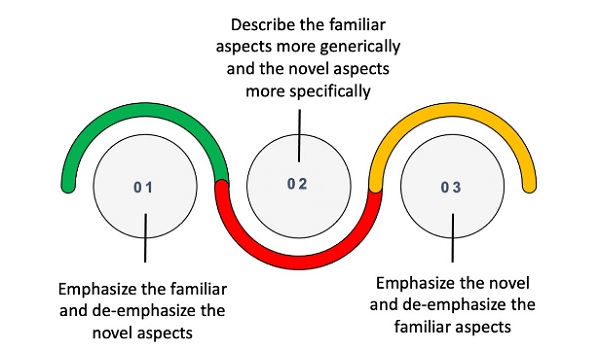
(source: Christopher Bingham et al, 2022)
Summary
"...it's more often customer perception than technological benefits that ultimately determines whether an innovation is adopted. Innovations must appear both familiar and novel to attract attention and gain traction......suggests it's better to emphasise an innovation's similarity to a prior solution - until it takes hold. Once innovation has gained wider acceptance, an organisation should focus on its valuable new attributes..."
Christopher Bingham et al, 2022a
How to frame innovations effectively
| "...Instead of doing this... |
Do this.... |
And get this result.... |
| Framing innovations as either familiar or novel |
Framing innovations as both familiar and novel |
More success promulgating innovation |
| Highlighting an innovation's distinctiveness during the earliest stage of adoption |
Begin by emphasising an innovation's similarity to prior solutions; minimise discussion of what is novel. | Increased consumer understanding and use of the new product, system, or process |
| Continuing to emphasise the new technology's familiar aspects as it takes hold |
Shift to emphasising its novel aspects |
Growing utilisation of and demand for the most novel features of the innovation; increasing recognition of its uniqueness and comparative advantage |
| Making all descriptions of a given innovation either more general or more specific over time |
Make descriptions that frame an innovation as familiar more generic over time; make those that frame it as novel more specific over time |
Effective transition from the familiar to the unfamiliar..." (source: Christopher Bingham et al, 2022a) |
NB People like something that is familiar and new; build on familiarity first, then switch to the novel aspects, ie anchoring the innovation to the familiarity and then later on accentuated its novelty; use generalisation and specification as techniques to get the transition right, ie initially generally align the innovation with the existing technology and then later differentiate it by increasing its specificity
"...management of change appears to hinge on deftly exploiting the duality of the familiar and the novel..."
Christopher Bingham et al, 2022a