Common Change Management Errors (99)
lxxxxix) Human Nature and Performance
Introduction
"...human nature can be very simple, yet very complex..."
Ali M Al-Khouri, 2010
Need to realise and understand that behaviours in organisations are determined by perceptions and personalities.
However, there are a
"...set of foundations and pivotal ingredients: self-motivation, assertive communication, personal empowerment, enhancing personal behaviour and interpersonal relationships..."
Ali M Al-Khouri, 2010
Having superior systems, processes, procedures, etc, does not guarantee success. What is more important for performance is accomplishing organisational-wide, shared common vision, purpose and sense of mission.
The key to organisational performance is the development of personal performance, skills, knowledge and experience; once high performance is achieved, then the challenge is to maintain it. To do this you need to understand individual differences, needs and behaviours, including learning styles in order to understand and handle organisational complexity.
"...our primary learning is touching the subject of perceptions, beliefs and values that motivate our behaviours and impact the overall learning process we may decide to follow..."
Ali M Al-Khouri, 2010
Need to understand human nature and motivation, ie what influences people to do what they do
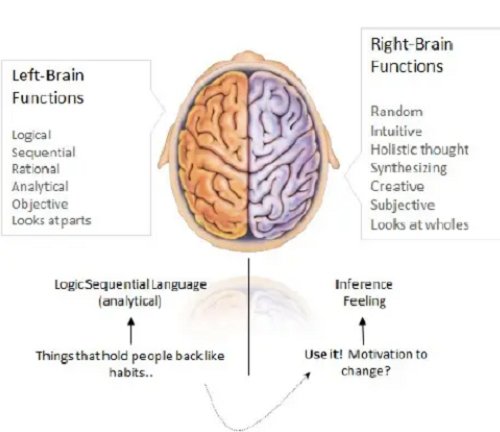
1. Left brain/right brain (for most of us, one side the brain dominates and influences the choice of thinking and learning style.
"...the left side has an exasperating devotion to numerical figures, details, analysis, time-bound logic, and sequential thinking, etc concerning itself with cash flow and the dire consequences of mismanagement of finances. It processes information in an analytical sequential way, first as separate pieces, and putting it together to get the whole.
The right side is often based on intuition, emotional decisions, synthesis, and holistic thinking, ie it processes information in an intuitive way, looking first at the whole picture and filling in the details. While this approach may yield immediate success in the short term, it often comes at the risk of long-term sustainability and growth..."
Ali M Al-Khouri, 2010
(source: Ali M Al-Khouri, 2010)
In most situations, 'balance thinking', ie engaging both sides of the brain, is the best approach to achieve and maintain high performance.
2. Beliefs and perception
Need to realise that our beliefs, perceptions can inhibit our learning and development, ie can inhibit right brain thinking.
Your behaviour can determine your beliefs, habits and needs.
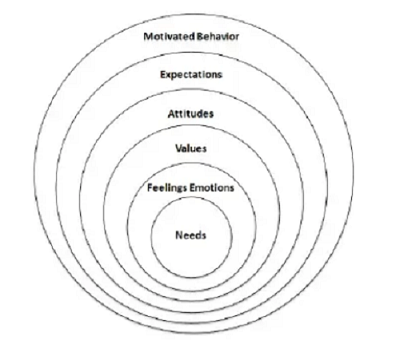
"...motivation is a hidden......stems from deep-rooted belief that activates performance and gives direction; it is strongest when it comes from our inner values......understanding motivation empowers us to better understand ourselves and others......enables us to change and/or further improve our behaviours and performance..."
Ali M Al-Khouri, 2010
Motivation factors
(source: Ali M Al-Khouri, 2010)
Furthermore, it is important to understand the links between our unconscious mind and particular motivated behaviours, ie
"...Our beliefs may be part of our unconscious mind and play the role of regulating many of our behaviours and actions we take in life..."
Ali M Al-Khouri, 2010
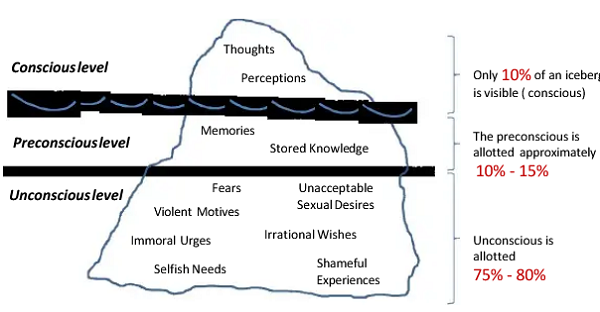
Mental iceberg of Freud's view of the human mind, ie 3 classification:
1. Conscious ("...awareness of one's environment in one's own existence, sensation, and thoughts, ie part of the mind that holds what we are aware of. We can verbalise about our conscious experience and think about it in a logical fashion..."
Ali M Al-Khouri, 2010)
2. Pre-conscious ("...memories or feelings that are not part of one's immediate awareneness but that can be recalled through conscious effort..."
Ali M Al-Khouri, 2010)
3. Unconscious ("...part of the mind containing elements of psychic make up, such as memories or repressed desires, that are not subject to conscious perception or control but that often affect conscious thought and behaviour..."
Ali M Al-Khouri, 2010
The below diagram (Freud's view of the human mind) shows around 90% of our thoughts are unconscious.
NB the unconscious thoughts have a major influence on our behaviours and instinctively make some decisions for us; our unconscious mind has a significant impact on what we can or cannot accomplish.
"...By challenging and changing some of our beliefs and perceptions, we can utilise our abilities and potential towards escalating our talents, achieving our goal and attaining significant success in almost every dimension of our progressive life..."
Ali M Al-Khouri, 2010
(source: Ali M Al-Khouri, 2010)
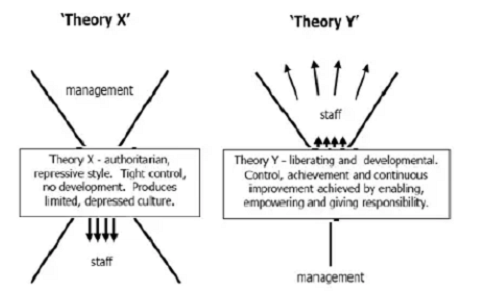
4. Theory 'X' and 'Y' (it is important to live and work in a positive environment. To build this environment you need to treat people as individuals and appreciate their personal differences, ie
"...all of us are individuals. We have different personalities. We think differently, we have different needs, wants, values and expectations, and goals. We each change over time as well. Therefore, we need to recognise people as individuals and work with their individual differences..."
Ali M Al-Khouri, 2010
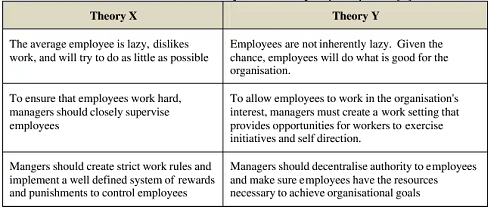
The diagram below shows two extremes of other people's potential and attitudes; theory X has a negative perception; while theory Y takes the opposite view assumes that other people can be self-correcting by seeking responsibility
(source: Ali M Al-Khouri, 2010)
Theory X and Y perceptions expanded
(source: Ali M Al-Khouri, 2010)
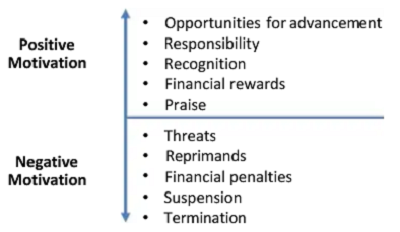
5. Motivation (the below diagram shows a continuum containing positive and negative motivation
(source: Ali M Al-Khouri, 2010)
"...positive leadership styles encourage development of employees and higher levels of job satisfaction. Negative leadership styles are based on the manager's ability to withhold items of value from employees. Result of negative leadership may be an environment of fear, where managers are viewed with distrust and seen as dictators rather than as leaders of team players..."
Ali M Al-Khouri, 2010
NB Perceptions, attitudes and behaviours are normally driven and motivated by needs, beliefs and values. Understanding what motivates you can help you understand other people's drivers of motivation.
Two categories of motivation theories are content and process:
i) content (what motivates behaviour; some examples
- Maslow's hierarchy of needs (it identifies 5 basic levels, ie physiological, safety, social, esteem and self-actualisation needs.)
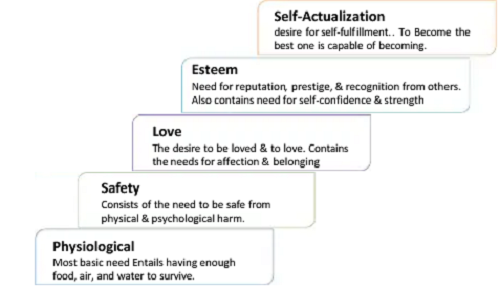
(source: Ali M Al-Khouri, 2010)
There are 4 premises:
"...1. individual's needs are arranged in a hierarchical order that starts from the most basic needs (water, food, shelter) to the most complex (esteem and self-actualisation),
2. only an unsatisfied need can influence behaviour, where a satisfied need is not considered to be a motivator,
3. a person with at least minimally satisfy at each level of need before feeling the need the move to the next level
4. The level of satisfaction of needs always fluctuates, ie if satisfaction is not maintained in need, it will become a priority need again. Once the need to satisfy is accomplished, it will cease to influence behaviour..."
Ali M Al-Khouri, 2010)
- Herzberg's two-factor theory (it uncovers 2 sets of factors
"...1. Motivators: factors that produce satisfaction and motivation
2. Maintenance or hygiene factors: factors that lead to dissatisfaction..."
Ali M Al-Khouri, 2010
If hygiene factors are present, serious dissatisfaction; conversely, if not present, there is no dissatisfaction; while motivators present can provide low to high satisfaction; if not present, no satisfaction
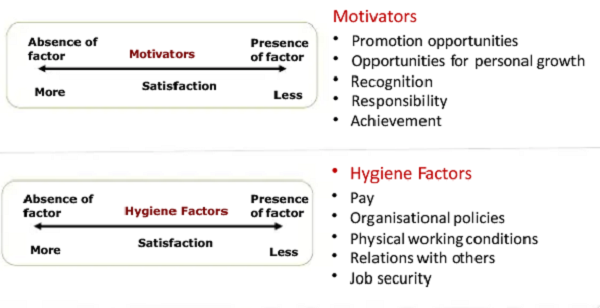
(source: Ali M Al-Khouri, 2010)
There is an overlap shared by both Maslow's and Herzber's theories; with hygiene factors predominately relegated to lower level needs and motivators target higher levels, ie
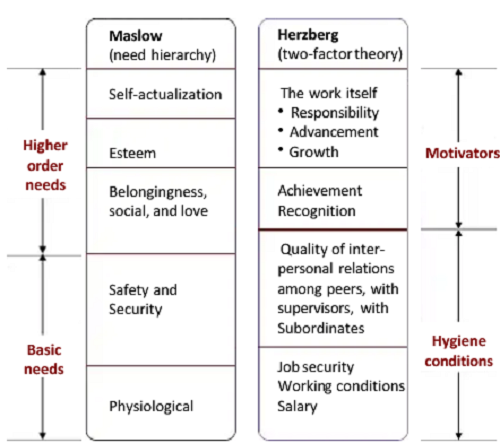
(source: Ali M Al-Khouri, 2010)
ii) process (concerned with how the content of motivation influences behaviour, eg
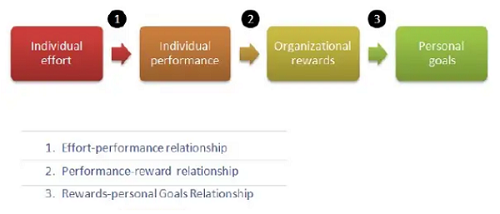
- Vroom's expectancy theory
(source: Ali M Al-Khouri, 2010)
This is linked with the Valence-Instrumentality-Expectancy theory and explains why people choose a particular behaviour to satisfy their needs.
"...It states or when choosing a behaviour, an individual will evaluate various possibilities on the basis of how much work is involved and what the reward is. Motivation is a function of how badly individuals want something and how likely they think they are to get it. It occurs in direct proportion to perceived or expected rewards..."
Ali M Al-Khouri, 2010
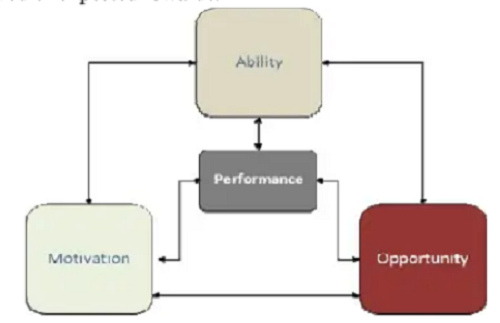
(source: Ali M Al-Khouri, 2010)
The above diagram indicates
"...The strength of a tendency to act in a certain way depends on the strength of an expectation that the act will be followed by given outcome and on the attractiveness of that outcome to the individual......behaviour is heavily influenced by perceptions of possible outcomes...... if an individual expects a certain outcome, possesses the competence to achieve it, and wants it badly enough, he or she will exhibit the required behaviour. If a person expects that specific behaviour will produce an outcome that he or she perceives as undesirable, he or she will be less inclined to exhibit that behaviour..."
Ali M Al-Khouri, 2010
NB Ability depends on education, experience and training; while motivation is more related to our thoughts:
"...the aim of motivation improves the quality of our thoughts..."
Ali M Al-Khouri, 2010
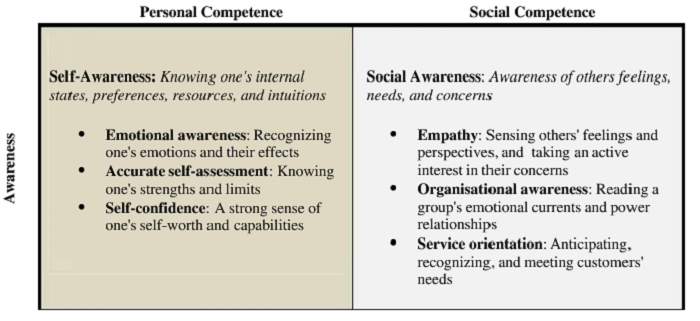
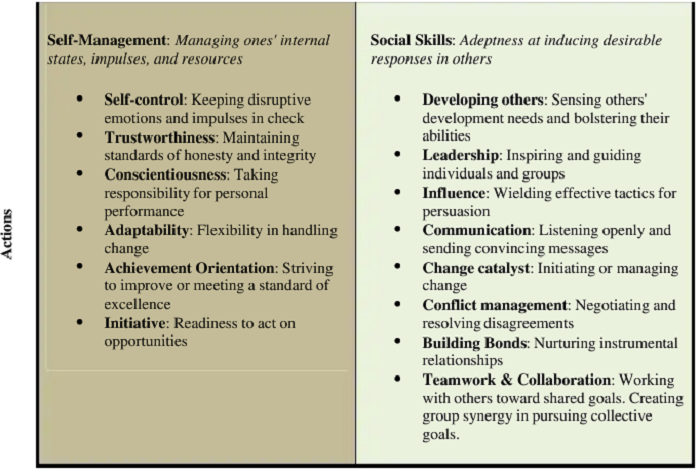
Competency framework
"...looks at 2 primary competencies: personal and social. Personal competencies are those that determine how we manage ourselves, where social competencies are those that determine how we handle relationships. It sets out skills, abilities, and personal qualities that leaders need to develop..."
Ali M Al-Khouri, 2010
This framework can be used to develop leadership competencies and identify training and development needs.