
Application of the on Hedonic Treadmill to Change Management
Introduction
In organisations, the Hedonic Treadmill explains why initial excitement about a change quickly fades, leading to:
- Low sustained engagement
- Backsliding into old habits
- Cynicism (“this too shall pass”)
- Change fatigue, etc.
To counter this, change leaders must engineer sustained motivation rather than rely on short-lived bursts.
How to Apply It to Change Management
1. Design change as a series of reinforcers, not a one-off event
Because people adapt quickly, major announcements, training days and launches lose impact within days or weeks.
Practical tactics:
- Introduce small wins every 2–4 weeks.
- Create incremental rollouts, not “big bang” launches.
- Celebrate progress markers, not only milestones.
2. Embed novelty and mastery into the change journey
If roles, systems or behaviours stop evolving, people habituate.
Build mastery loops:
- Skill-building pathways
- Micro-learning
- Role redesign with stretch tasks
- Career mobility linked to the change.
3. Use intrinsic motivators (not just incentives)
Money, bonuses and praise wear off quickly.
More enduring motivators:
- Autonomy: Let teams shape how they adopt the change.
- Purpose: Link the change to meaning and impact.
- Mastery: Provide learning paths.
- Belonging: Use team-based adoption and peer modelling.
4. Reduce comparison traps in the workforce
When people compare themselves to departments further ahead, motivation drops.
Use:
- Transparent dashboards
- Normalisation of different adoption paces
- Recognition of unique team contexts
- “Team of teams” storytelling.
5. Stabilise expectations early
Overhyping creates inevitable disappointment once adaptation sets in.
Under-communication creates confusion.
Instead:
- Communicate balanced expectations (“This will improve X, but it may make Y harder at first”).
- Set realistic timelines so that people don’t expect miracles.
- Talk openly about adaptation (“The new system will feel awkward at first, then normal”).
6. Use ritualisation to anchor new behaviours
Habits survive adaptation better than motivation. Replace emotional spikes with routines.
Examples:
- Weekly reviews
- Daily stand-ups
- Monthly “change reflection” meetings
- Post-implementation check-ins.
7. Make progress visible
People quickly forget how far they’ve come.
Use:
- Before/after metrics
- Visual progress boards
- Stories that highlight real improvements
- Regular leader narratives (“Here’s what’s now possible…”).
Summary
Getting off the Hedonic Treadmill means designing life (including organisational change) in ways that:
- Slow adaptation
- Reduce reliance on novelty
- Build intrinsic motivation
- Create sustained engagement
- Reinforce progress over time.
In change management, this translates into:
- Ongoing small wins
- Mastery-building
- Intrinsic motivations
- Habit formation
- Continuous reinforcement
- Realistic expectations
- Visible progress
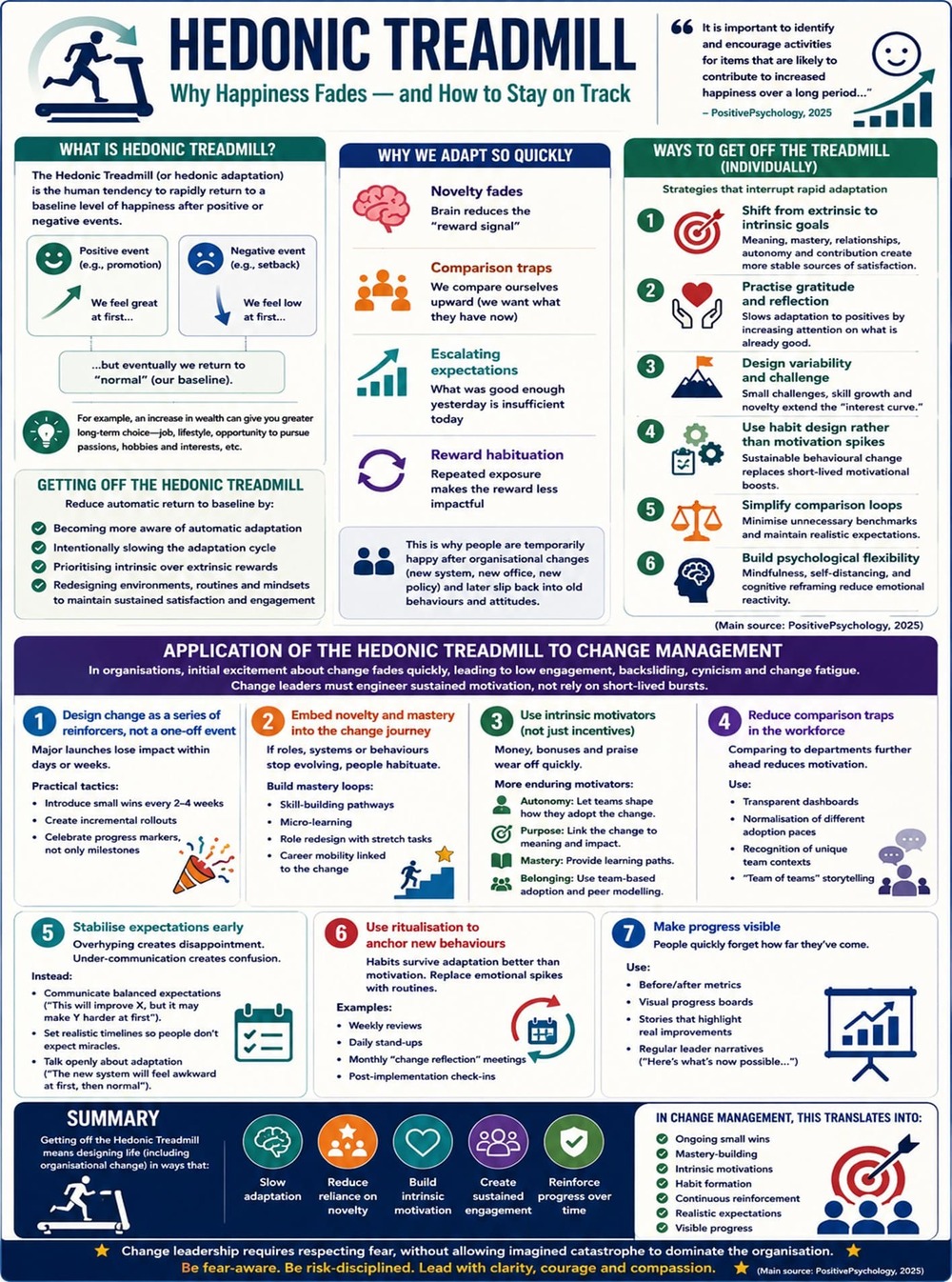
(main source: PositivePsychology, 2025)