
Framework 208 EPIC Change Communication Framework
Introduction
Effective communication increase certainty which reduces fear and builds trust in the organisation and leadership.
Need to remember that people have different responses to change and different needs when you communicate: there is no one-size fits-all approach; need to be able to adapt your communications so that they resonate with the different stages of the change.
Need to be more of a focus on people and less on deliverables.
Having an understanding of neuroscience (how the brain works) and behavioural science (understand people's needs and motivations) is important to success.
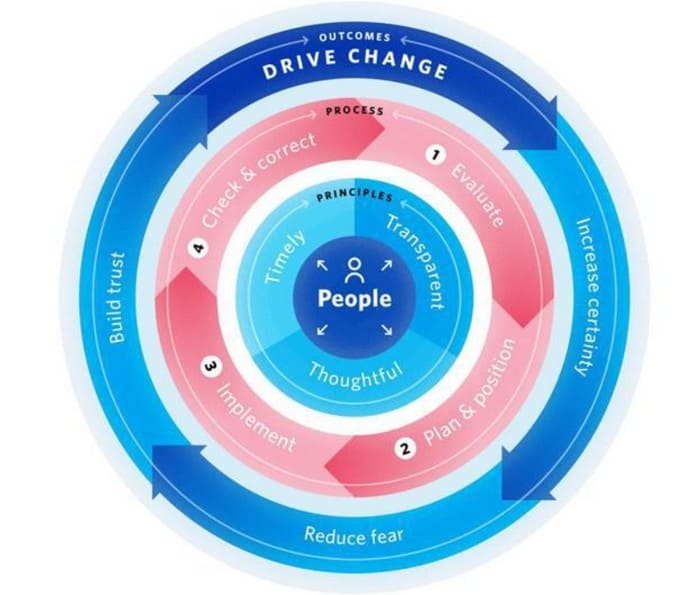
EPIC is the step-by-step process for designing and delivering change communication. It includes:
-
Getting a good brief: defining the scope and impact of the change (what is actually changing, who it affects, how it is going to be done).
-
Developing FAQs and key messages that resonate with people.
-
Building a communication strategy and plan that align with behaviour, emotion and impact.
-
The role of leaders: preparing and enabling leaders to communicate and drive change.
-
Measuring effectiveness: how to know whether your communication is working and using feedback and metrics to improve.
Key Concepts of EPIC
EPIC stands for Evaluate & Establish, Plan & Position, Implement, and Check & Correct; a 4-step process that forms the bedrock of the entire framework.
At the core of the framework is people, because that’s what change is all about - people, not deliverables.
As you progress through each step of the framework, you will also learn about what goes on in people’s heads, and how we can use that knowledge to influence people’s behaviours and support successful change. By combining a practical framework with elements of behavioural science, you will have everything you need to communicate change effectively and with a level of expertise that will shine through!
EPIC Framework
| Step | What You Do | Key Questions | Practical Tips |
|---|---|---|---|
| E – Evaluate & Establish (Clarity) | Get a good brief, define scope & impact. | • What’s changing? • Why now? • Who’s impacted? |
Map stakeholders, impacts, risks. Document what won’t change to reduce anxiety. |
| P – Plan& Position (Strategy) | Build comms strategy & roadmap. | • What outcomes do we want? • How will we measure success? |
Choose channels, timing, and sequencing. Include FAQ & key messages. |
| I – Implement (Delivery) | Execute the comms plan. | • Are we reaching the right audiences at the right time? | Use multiple formats (email, town halls, video, leaders). Leverage emotional storytelling. |
| C – Check& Correct (Measure & Adapt) | Measure results, refine, iterate. | • Are people engaging, understanding, adopting? | Collect feedback, pulse surveys, leader check-ins. Adjust messaging quickly. |
(source: Mel Loy, 2024)
Detailed Breakdown: EPIC Change Communication Framework
E – Establish/Evaluate (Clarity & Foundations)
Goal: Build a rock-solid foundation for communication before sending a single message.
Key Activities:
- Define the change clearly (understand the scope of change: the brief: what exactly is changing, why now, and what does success looks like (benefits, etc? Identify what is staying the same and what is being replaced).
- Impact analysis (map who is affected, how deeply and whether it is a positive, neutral, or negative impact for them).
- Stakeholder mapping: Identify primary, secondary and tertiary audiences; note their influence and level of interest; try to understand the level of impact of change on different stakeholder groups and their level of control over that change. Audience groups can be classified as:
- Change influencers (high control and low impact; can be important in explaining the why)
- Change leaders (high control and impact; need to be engaged early in the process to help influence the change process)
- Interested observers (have low impact and control; barely impacted by the change, if at all; media, communities, etc)
- End users (have high impact and low control; usually the largest group of stakeholders like staff, customers, etc)
- Baseline assessment (understand current awareness, sentiment, and readiness for change eg, surveys, focus groups; from the scope of change determine the most frequently asked questions (FAQ); structure your FAQ by audience, by organisational level or by phase so that you are able to identify the gaps in the change process.
Some examples of FAQ:
- what is changing?
- what do you have to do differently?
- why do you need to change now?
- impact on other projects and operations?
- what are the potential obstacles in the change process?
- what training and development will be provided?
- what will the impact on all stakeholders, such as, staff, customers, etc?
- when is the project expected to be completed?
- how will you know if it is successful?
- Key risks & blockers (what misinformation, obstacles, fears or competing priorities could derail change adoption?)
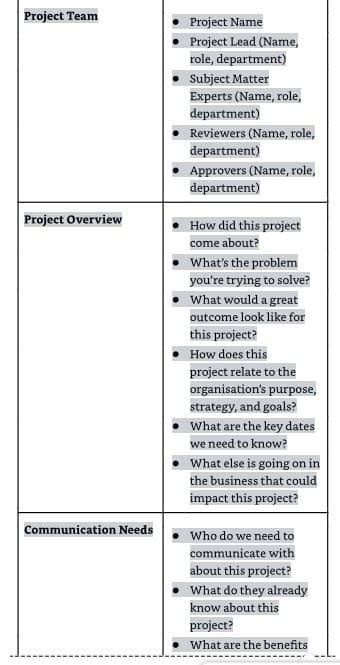
Deliverables:
- Change brief or “one-pager”
- Impact map (who + what changes)
- Risk register/stakeholder analysis
- Briefing template
(source: Mel Loy, 2024)
P – Plan and Position (Strategy & Roadmap)
Goal: Create a strategic, audience-focused communication plan that is aligned with business objectives and involves a dialogue.
Key Activities:
- Set communication objectives (what do we want people to know, feel and do as a result?)
- Craft key messages (develop core messages, such as the why for the change, supporting FAQs and leader talking points tailored for each audience; it is more than just broadcasting information.)
- Select channels & timing (Email? Town halls? Yammer/Teams? Video? Decide on the right mix for each group.)
- Determine cadence & sequencing: Time messages to coincide with milestones, decisions, or actions required.
- Align with other initiatives: Avoid communication overload; integrate with other projects if needed.
Deliverables:
- Communication strategy document
- Message framework & FAQ pack
- Channel/timing roadmap
NB
- Keep people at the centre of the communication planning process (need to understand your different audiences’ needs)
- Realise the differences between change communications and other forms of communications (internal communications are generally short term while change communication is more long term and more focused on a specific audience.
Difference between change and internal communication objectives is that they serve different purposes
| Change communication objectives | Internal communication objectives |
|---|---|
| To demonstrate an in-depth understanding of the scope and impact of change | To use internal communication to build support for organisational strategy and drive employee engagement |
| Draw on a deep understanding of human behaviour; how to adapt communication approaches and styles to get the desired change accepted | Support senior leaders to build their brand internally |
| Get granular communication outcomes, strategies and tactics to address specific impacts | Develop campaigns where the primary objective is to build awareness, eg campaigns on safety, inclusion, etc |
| Emphasise leadership communication and coach leaders to communicate change effectively to their employees | Manage operational communication by supporting frontline employees of business-as-usual, daily operations, etc |
| Employ a range of techniques to make change easier to understand; influence people’s opinions and actions | Manage crisis communications and issues management from an internal perspective |
| Help people move from awareness to understanding to acceptance, adoption and sustained behaviour change | Manage and govern internal communication channels |
(main source: Mel Loy, 2024)
I – Implement (Delivery & Engagement)
Goal: Bring the plan to life with consistent, engaging, multi-channel messaging.
Key Activities:
- Launch communications (send announcements, run town halls, publish intranet content.
“…Survey found that when leaders are able to communicate what change means for the future of the organisation, their employees are much more engaged (86% engagement) than those employees who leaders have not articulated a vision for the future (22%)…”
Gallup as quoted by Mel Loy, 2024
NB Stakeholders are more likely to trust and listen to their immediate leaders than anybody else in the organisation.
- Check that the impacted stakeholders have the expertise, capability, resources etc required to transition to the new situation (if expertise needs to be developed, have the required training and development resources available)
- Enable leaders (provide briefing packs, slide decks, Q&A sheets so leaders can cascade messages confidently)
NB There is a disconnect between the perception of leaders and their staff around communications:
- 80% of leaders feel they share enough information for their staff to perform well; however, 50% of staff disagreed
- 70% of leaders feel that their staff have access to information to understand the organisation’s goals and directives to do the job effectively; yet 50% of staff disagreed
- 80% of leaders think their communications output is helpful and relevant; however, 50% of staff disagreed
(main source: AxiosHQ as quoted by Mel Loy, 2024)
NB The more layers of staff within the organisation, the greater the chance of disconnect between leaders’ perceptions of their communication impact and the reality.
- Use multiple formats: Mix written, visual, and face-to-face to reach all learning styles.
- Engage emotionally: Tell stories, highlight benefits and connect the change to personal impact.
- Create feedback loops at all organisational levels: Encourage 2-way conversation, gather reactions, address concerns, misinformation, etc quickly.
Deliverables:
- Leader briefing sessions
- Launch events / videos / digital campaigns
- Feedback capture mechanisms (Q&A channels, pulse surveys)
C – Check (Measure, Learn & Adapt)
Goal: Ensure communications are working, and refine if they are not.
Key Activities:
- Collect feedback: Use pulse surveys, polls and informal feedback channels to gauge understanding and sentiment.
- Track adoption metrics: Measure attendance, engagement rates and behaviour shifts (eg, system usage, process compliance).
- Assess message resonance: Are people repeating key messages? Do leaders feel prepared?
- Iterate quickly: Adjust tone, frequency, or channels if something isn’t landing.
Deliverables:
- Metrics dashboard (engagement, adoption, sentiment)
- Lessons learned report for future change programs
Summary
EPIC
E: If you skip the establish and evaluate foundation, people get confused and mistrust grows.
P: Poor planning results in noisy, inconsistent or duplicated communications that lead to change fatigue.
I: implementation or delivery should be more than email; you need visibility, storytelling and trusted voices.
C: Without checking via measurement, you don’t know if change is landing and risk wasting effort.
Core Principles
- People first: Understand emotional & rational responses.
- Clarity over complexity: Simple language beats jargon.
- Leader-led, communication-enabled: Leaders are trusted messengers.
- Two-way communication: Listen and respond, not just broadcast.
- Behaviour focus: Measure adoption, not just message delivery.
“…from internal and external communication to government relations, community relations, media, investor relations, and even corporate social responsibility. Change communication is another specialisation, and requires a different set of skills and knowledge to master…”
Mel Loy, 2024