
Framework 199 — Natural Laws of Organizational Transformation
Introduction
McKinsey & Company (1993) articulated a set of principles that describe how organizations can effectively manage and sustain transformational change. These "laws" highlight that successful transformation is not about quick fixes, but about aligning structure, people and processes with purpose and strategy.
Natural Laws of Organizational Transformation
- Leadership Starts at the Top
- Real transformation must be driven by top leadership.
- Executives need to model the change they want to see.
- Without leadership ownership, change efforts usually stall or fail.
- Change Starts with a Compelling Case
- There must be a clear and urgent reason for change.
- Organizations need a shared narrative explaining why change is necessary and what happens if nothing changes.
- Engage the Whole Organization
- Transformation is not just a top-down process.
- People at all levels must be involved — especially middle managers and frontline employees.
- Engagement fosters ownership, trust and commitment.
- Behaviour Change Drives Results
- Structural changes alone don’t work; real results require changes in mindset and behaviour.
- Leaders must reinforce desired behaviours through communication, reward systems and accountability.
- Sustained Energy is Required
- Transformation is not a one-off event; it needs long-term focus and energy.
- Without consistent reinforcement, organisations revert to old habits.
- Measurement Matters
- Organisations must define and track clear success metrics.
- What gets measured gets managed.
- Feedback loops help organizations adjust and learn along the way.
- Align Structure, Culture and Strategy
- Organisational transformation is only successful when culture, systems and people are aligned with the strategy.
- Misalignment weakens momentum and causes confusion.
Summary
McKinsey’s Natural Laws of Organizational Transformation (1993)
|
Principle |
Key Message |
|
|
1 |
Leadership Starts at the Top |
Transformation begins with strong, visible leadership. |
|
2 |
Build the Case for Change |
Create urgency and a shared vision for why change is needed. |
|
3 |
Involve the Whole Organization |
Engage people at all levels to foster commitment. |
|
4 |
Focus on Behaviour |
Sustainable change requires changing behaviours, not just systems. |
|
5 |
Keep the Energy Up |
Transformation takes time and continued focus. |
|
6 |
Measure What Matters |
Use data to track progress and guide decisions. |
|
7 |
Align Everything |
Strategy, culture and operations must work together. |
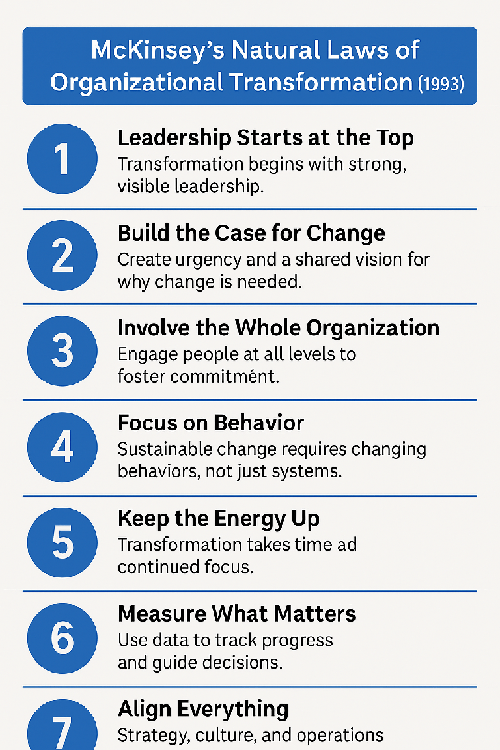
(source: McKinsey, 1993)
Updating the above framework
Introduction
Most organizational transformation efforts mostly fail; this happens not because the strategy is wrong but because the system is misunderstood: most organizations treat transformation as a series of disconnected initiatives.
However, transformation is not about isolated projects. It’s about how every part of your system thinks, behaves and evolves - together.
Back in 1993, McKinsey defined the “Natural Laws of Organizational Transformation.”
Decades later, these principles still hold true, especially if your organization is navigating high-stakes transformation.
A modern breakdown of those timeless laws:
- Performance must be the end goal (measured, shared and meaningful.)
- Strategy and structure still matter.
- No vision survives a weak foundation.
- Teams are your real leverage point.
- Culture shifts happen gradually, ie team by team.
- Your processes must reflect your values.
- Misalignment breaks trust.
- Take a learning-oriented approach.
- Adaptation over perfection.
- Above all - focus.
- Energy diffused is energy wasted.
- Think in systems, not silos.
- Activate to view larger image,
These are golden principles for building a system that transforms from within.