
Framework 198 — Balanced Change Card (BCC)
Introduction
The Balanced Change Card (BCC) is a comprehensive framework designed to guide organizations through effective change management by integrating multiple perspectives.
The BCC is a dynamic tool using a systems approach that assists in both the design and evaluation of organizational change initiatives.
“…Approach makes it possible to view the change management explicitly from different perspectives and spotlights relevant causal links…… Each perspective on reality leads to a different interpretation of the phenomena that occur…”
Esther Koster et al, 1998
Need to keep the dimensions in balance
“…To remain viable, organisations have to keep several dimensions in balance: each of these dimensions is anchored by opposing concepts, such as consensus and dissension, planning and opportunism. So keeping them in balance requires multiple processes that contest with each other…”
E. Miles, et al as quoted by Esther Koster et al, 1998
Some other balances include control without rigidity; internal and external influences
The BCC approach involves 4 key system functions for effectiveness.
Four Key System Functions (see figure 1 below)
- Adaptive Function/Open System Perspective (change manager as a mediator; emphasizes the organization's ability to adapt to external environmental changes.
“…To realise the timely adaption to change requirements and to meet priorities of concerned parties (adaptive function). We refer to this as change definition…”
Parson as quoted by Esther Koster et al, 1998
Some critical issues include urgency, clear and shared vision, powerful coalitions, strong top management involvement.
Some strategies to help with this include collective diagnoses, scenario planning, timely communications, etc)
- Maintenance Function/Human-Relations Perspective (change manager as team builder, mentor, coach and stimulator; focuses on internal cohesion, employee well-being and organizational culture.
“…To bring people together in change-teams and to transform them into harmonious units (pattern maintenance and tension-maintenance function). We refer to this as change staff…”
Parson as quoted by Esther Koster et al, 1998
“…To promote openness, cooperation, loyalty and motivation, the application of measures in the areas of selection and participation, training and education, team building and conflict resolving, is a priority…”
Esther Koster et al, 1998)
- Goal Attainment Function/Rational Goal Perspective (change manager as a producer; focuses on setting and achieving clear organizational objectives; using minimal resources to promote achievement and results-orientated behaviours.
“…To guarantee goal and results-orientated change endeavours (goal-realisation function). We refer to this as change design…”
Parson as quoted by Esther Koster et al, 1998)
- Integrative Function/Internal Process Perspective (change manager as a controller and coordinator; creation of a sense of stability; highlights the importance of internal processes, communication and coordination; defining roles and responsibilities; establish a process of regular performance reviews.
“…To safeguard the management of the change process through application of rules (integrative function). We refer to this as change governance…”
Parson as quoted by Esther Koster et al, 1998)
These perspectives collectively ensure a balanced approach to managing change, addressing both external adaptability and internal stability.
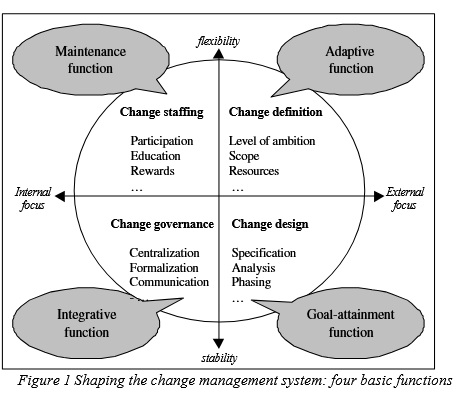
(source: Esther Koster et al, 1998)
Core Components of the BCC Framework (see figure 2 below)
The BCC framework identifies 4 central issues critical to successful change management:
- Domain of Change (determining the specific areas within the organization that require change.)
- Staffing of Change (assigning the right personnel and teams to lead and implement change initiatives.)
- Planning of Change (developing structured plans that outline the steps, timelines and resources needed for change.)
- Governance of Change (establishing oversight mechanisms to monitor progress and ensure accountability.)
By addressing these components, organizations can create a comprehensive roadmap for change that is both strategic and actionable.
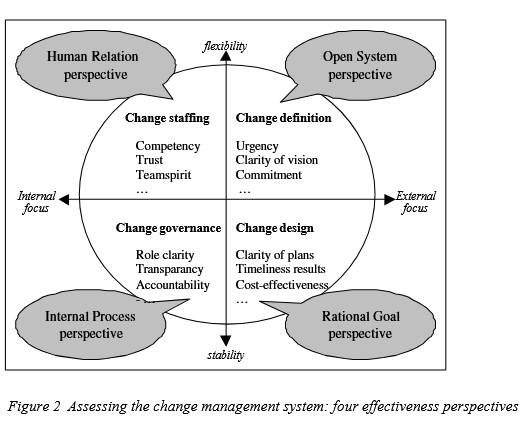
(source: Esther Koster et al, 1998)
Application and Benefits
The BCC serves as a reflective tool for change managers, enabling them to:
- Integrate Diverse Perspectives (by considering multiple viewpoints, the BCC helps in understanding the complex nature of organizational change.)
- Identify Success Conditions (It aids in pinpointing the necessary conditions and actions required for successful change implementation.)
- Assess Effectiveness (the framework provides criteria for evaluating the success of change initiatives, ensuring continuous improvement, etc)
Utilizing the BCC can safeguard organizations against unbalanced activities and assessments, promoting a more holistic and effective approach to change management.
An indication of shifting consequences during the change management system life cycle is shown below in figure 3
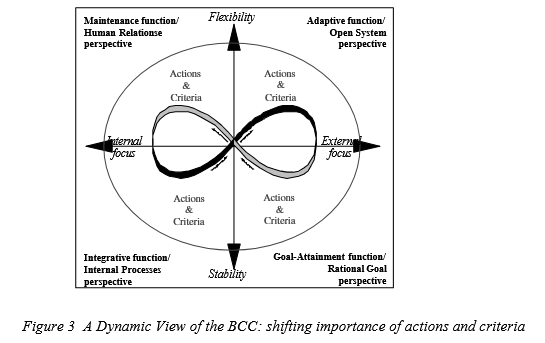
(source: Esther Koster et al, 1998)
Summary (Phases 1 to 4)
Phase 1: Orientation
Purpose: To explore and understand the change challenge in its full complexity.
Key Activities:
- Clarify the need for change.
- Identify the initial change goals and stakeholders.
- Explore the organizational context, including current tensions or triggers.
- Use multiple perspectives (open systems, human relations, internal processes, rational goals) to frame the change challenge.
Outcome: A shared understanding of the why, what and who of the change initiative.
Phase 2: Diagnosis
Purpose: To analyse the organization in detail from four systemic perspectives.
Key Activities:
- Diagnose the external environment and how the organization adapts (Open Systems).
- Examine people, culture and group dynamics (Human Relations).
- Review processes and structures (Internal Processes).
- Assess strategy, goals and results orientation (Rational Goals).
- Identify strengths, weaknesses and misalignments.
Outcome: A comprehensive diagnostic profile showing where imbalances exist and where change efforts should focus.
Phase 3: Design
Purpose: To plan a balanced and integrated change strategy.
Key Activities:
- Develop interventions across the four domains:
-
-
-
- Change domain – What needs to change?
- Staffing – Who leads the change and how?
- Planning – What actions, steps and timelines are needed?
- Governance – How is oversight and learning managed?
-
-
- Consider balance between internal vs external and flexibility vs control dimensions.
- Integrate stakeholder input and validate choices.
Outcome: A Balanced Change Card – a structured, multi-perspective plan aligned with the organization’s context and needs.
Phase 4: Evaluation
Purpose: To assess progress, outcomes and systemic effects of the change.
Key Activities:
- Measure progress against goals (Rational Goals).
- Gather feedback on engagement, learning and wellbeing (Human Relations).
- Check for improvements in coordination and information flows (Internal Processes).
- Re-evaluate fit with external demands (Open Systems).
- Adapt the plan based on insights and feedback loops.
Outcome: A well-rounded assessment of what’s working, what’s not and where to recalibrate – ensuring continuous learning and adjustment.
Summary
|
Phase |
Focus |
Outcome |
|
Phase 1 |
Orientation |
Understanding context, need and goals |
|
Phase 2 |
Diagnosis |
Holistic analysis of organizational state |
|
Phase 3 |
Design |
Balanced, multi-perspective change plan |
|
Phase 4 |
Evaluation |
Evidence-based assessment and feedback |
BCC as a change management framework
“…1. Offering a frame of reference for the functioning of the change management system;
- Functioning as a communication vehicle when giving direction to the change process;
- Offering a foundation of change management information system;
- Creating a learning-instrument through the comparison of approaches to change;
- Offering a foundation for an evaluation and reward-instrument for a project team…”
Esther Koster et al, 1998
NB
“…The Balanced Change Card offers multi-perspective on the change management system. Each perspective sheds light on specific conditions for success, on actions needed to obtain the success and effectiveness criteria used to determine the degree to which the critical success conditions have actually been attained…… Change managers are able to test their own blend of actions balance. Consequently, ‘blank spots’ and ‘black holes’ in the design of change management system can be avoided. By applying measures in all four systems-functions, it becomes possible to the critical success conditions of the change-organisation. Furthermore,……It becomes possible to compile a set of evaluation criteria to offer balanced insight the functioning of the change management system. Testing it against the four different effectiveness perspectives guarantees exposure of each to close scrutiny…”
Esther Koster et al, 1998
BCC is a dynamic process