
Technique 5.20 Procrastination
Introduction
Procrastination is defined as
"...Delaying or avoiding something that would ideally be carried out in the present..."
Elaine Houston, 2024a
This results in sub-optimal behaviour that undermines and compromises productivity in the workplace.
Generally, procrastination is more than just a sign of laziness or poor time management.
Luckily procrastination is a behaviour that can be challenged and eliminated.
This technique will help you identify how procrastination manifests and reflect on how to challenge and eliminate it so that you can organise and manage your time effectively and efficiently.
Eliminating procrastination is not a quick fix; it requires practice and focus.
If you feel that eliminating procrastination is impossible, it is best to take many small possible actions.
Generally, the process involves multiple attempts.
Steps (6)
1. Identify the tasks you typically procrastinate about (list 5 tasks you typically put off or avoid, eg tasks you wait too long to complete such as home calls, responding to e-mails, dealing with customer complaints, etc.)
| Task no | Procrastinating tasks (details) |
| 1 | |
| 2 | |
| 3 | |
| 4 | |
| 5 |
2. Identify your procrastination behaviours (think about how your procrastination shows; list 5 procrastination behaviours that you recognise in yourself - see below table.
Some common procrastination behaviours include:
"...- waiting until the last moment to start the task
- spending too much time planning how to complete a task
- spending longer than needed to complete a task or project
- not starting something because it needs to be 'perfect'
- not completing something until it is 'perfect'
- working on non--important/non-urgent tasks
- delaying or avoiding difficult tasks
- delaying/avoiding boring tasks
- waiting for the 'right moment' to work on a task..."
Elaine Houston, 2024a
This list is not exhaustive and should help you think about how your program of activities, events, etc; and other behaviours, if appropriate.)
3. Identify why you procrastinate (think about why you procrastinate; some examples include:
- perfectionism
- fear of failure
- fear of the unknown
- pleasure seeking
- handling boredom
- seeking control
- doing things your way
- lack of self-confidence
- feeling overwhelmed, etc
(for more details, see elsewhere in the Knowledge Base))
4. Identify ways to eliminate each behaviour (see the list of possible solutions:
- plan rewards (a good way to handle boring tasks, ie planning to enjoy a reward after completing a task can motivate you to get started on something you have been avoiding)
- introduce restrictions and remove distractions (to help reduce procrastination, use self-imposed restrictions and removal of distractions, eg if you browse social media excessively, limit your use to certain times of the day, unless important or urgent)
- set a time limit (this will help you get started on overwhelming and/or unappealing tasks, eg set a timer for 5 minutes and focus on a specific task for that time.
"...the idea that once you start working, you will gain momentum, making it easier to keep going..."
Elaine Houston, 2024a)
- allow yourself to make mistakes (think of mistakes as positive learning opportunities that are part of personal/professional growth and improvement; can be helpful for procrastinators who are perfectionists; remember everybody makes mistakes and no one is perfect)
- scheduling/setting time limits (plan a daily schedule so that know what you need to do and how long each task will take; try to rigidly stick to that time schedule; however, you will need to be flexible, as unexpected events will happen)
- adjusting unhelpful assumptions (be prepared to challenge your own rules and assumptions that you believe and live by as they can be misguided and unhelpful.
"...Unhelpful assumptions often involve language like 'should', 'must', or 'can't'.....you might put things off because you think......'I can't do this, so I won't try'......you can challenge a rigid way of thinking by reminding yourself that you can do more than you give yourself credit for, you can tolerate some discomfort when things go wrong, and no one expects perfection..."
Elaine Houston, 2024a)
- do the worst first (work on the least enjoyable or most challenging tasks at the start of each work day; then move to the more enjoyable task:
"...The idea behind this approach is that once you have completed a task you have been delaying or avoiding, you can move on to more enjoyable tasks and the rest of the day will feel easier..."
Elaine Houston, 2024a)
- divide tasks into manageable chunks (if procrastinating about the task, divided into mini-tasks that are easier to handle))
5. Take action (after identifying your procrastination behaviours, causes and potential solutions, it's time to develop specific actions, ie steps to implement your chosen solutions)
6. Reflect (answer the following questions:
"...- In what ways did you find this exercise helpful?
- After completing this exercise, what insights have you gained about procrastination?
- How will you use these insights to help you minimise procrastination in the future?
- In what ways has this exercise helped you manage your workload more effectively?
- Did you find any part of this exercise challenging? If so, how did you overcome this?
Elaine Houston, 2024a)
Summary table
| Tasks | Procrastinating tasks*i | How I procrastinate (behaviour)*ii |
Why I do it*iii |
Solutions*iv |
Action*v |
Reflection*vi |
| 1 | ||||||
| 2 | ||||||
| 3 | ||||||
| 4 | ||||||
| 5 |
Notes
i) see step 1
ii) see step 2
iii) see step 3
iv) see step 4
v) see step 5
vi) see step 6
An example
Tasks that you procrastinate about:
- cold calling customers
- complex reports
- responding to e-mails
- unfamiliar projects
- dealing with customer complaints
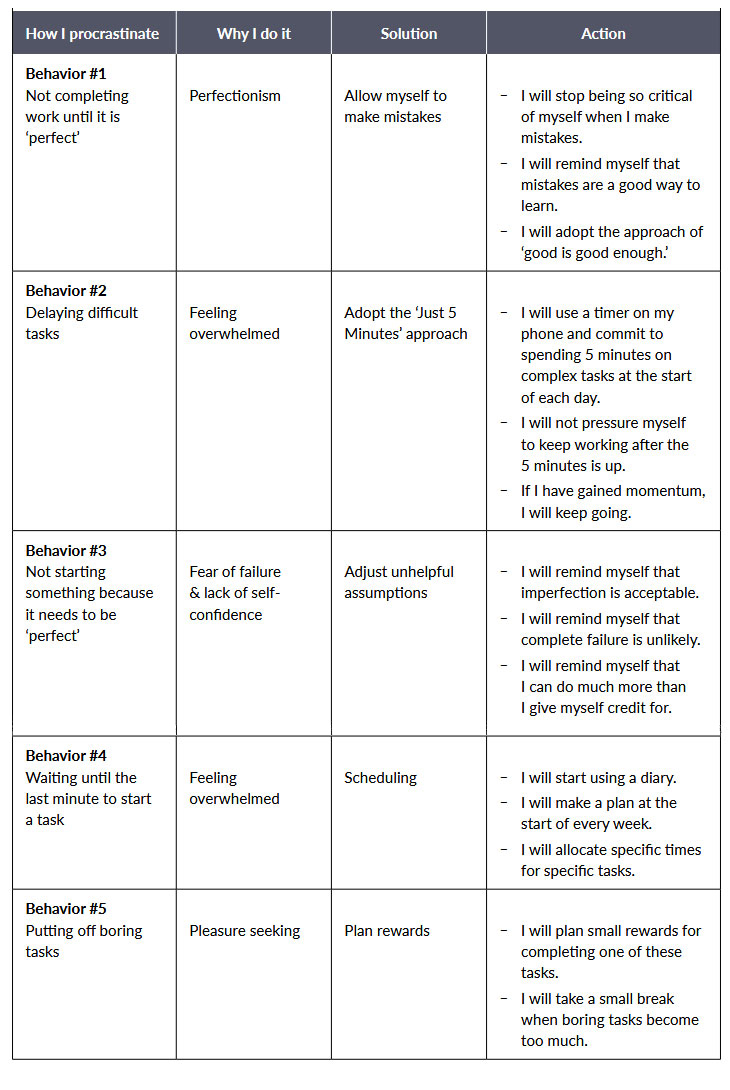
(source: Elaine Houston, 2024a)