
Framework 45 Eight Steps to Organisational Change
Introduction
Underlying Kotter's 8 step model:
i) people prefer the status quo (change creates uncertainty; uncertainty makes people feel uncomfortable; people tend to mistrust things that are uncertain; therefore, the need to create a sense of urgency to overcome this)
ii) handling resistance (to form a powerful coalition of credible staff working with all staff, especially the resistors)
iii) creating a plan (involving a vision for the future with strategies will encourage cooperation and a move away from 'business as usual' or status quo thinking; the plan has to be communicated throughout the organisation)
iv) suitably reward and recognise staff for their performance (positive reinforcement encourages, motivates and inspires them to change)
v) remove barriers/obstacles to change (provide the appropriate training so they have the expertise to handle the new ways; encourage appropriate risk-taking and creative problem solving)
vi) link the relationship between the new behaviours and the organisation’s success (highlight the benefits of change; be prepared to make appropriate adjustments during the change implementation; make the change permanent, otherwise staff will drift back to the status quo.)
John Kotter studied why organisational transformations failed. This formed the basis for an 8 steps framework which is summarised below:
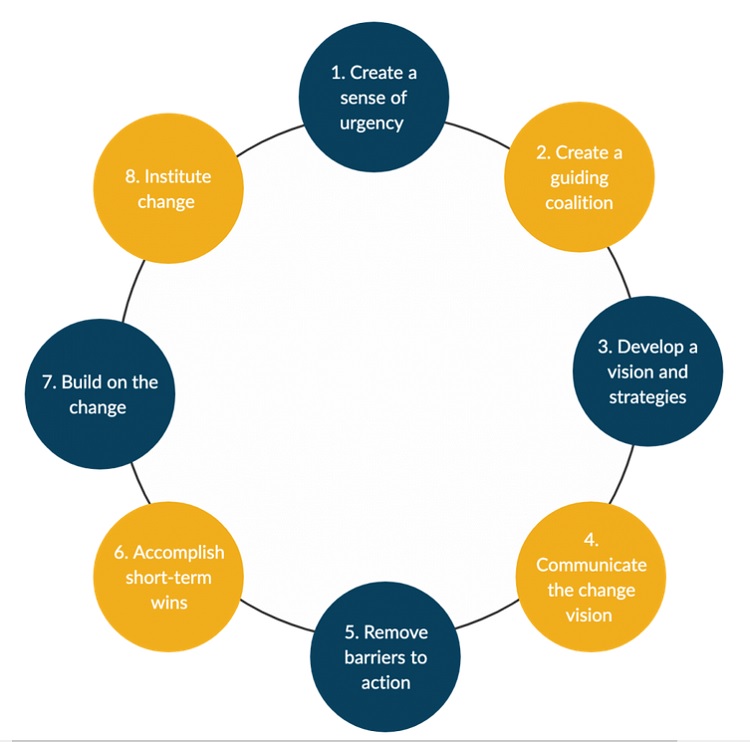
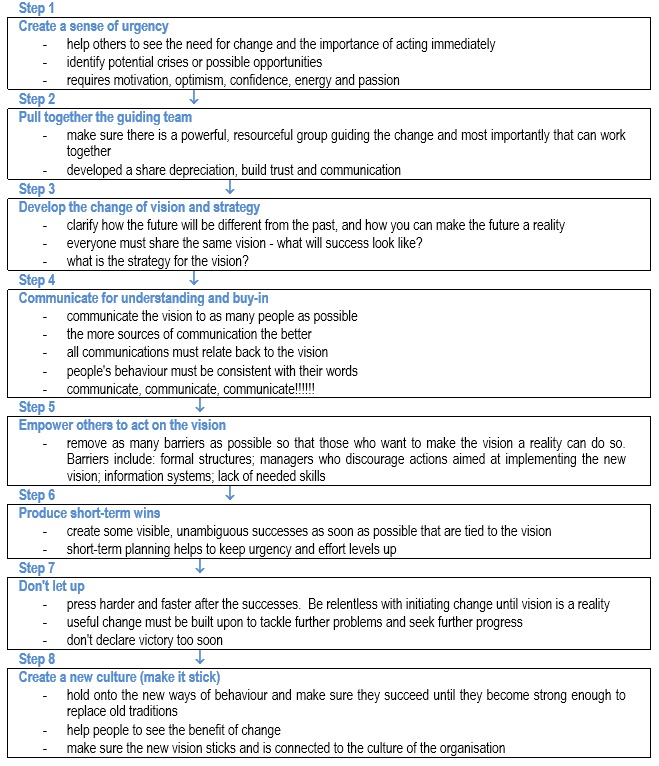
NB Steps 1 (create a sense of urgency) and 2 (pull together the guiding team) set the stage; step 3 (develop the change of vision and strategy) is deciding what to do; step 4 (communicate for understanding and buy in) to reinforce the purpose, step 5 (empower others to act on the vision), step 6 (produce short-term wins) and step 7 (don't let up) make it happen; step 8 (create a new culture) make the change stick.
The table below explains the right action at the different stages, with common pitfalls.
|
Stage
|
Action
|
Pitfalls
|
| 1. Creating a sense of urgency | i) Examine market and competitive realities for potential crises and untapped opportunities ii) Convince at least 75% of your managers that status quo is more dangerous than the unknown |
i) Underestimating the difficulty of driving people from their comfort zones ii) Becoming paralysed by risks |
| 2. Form a powerful guiding coalition | i) Assemble a group with shared commitment and enough power to lead the change effort ii) Encourage them to work as a team outside the normal hierarchy |
i) No prior experience in team work at the top ii) Relegating team leadership to an HR, quality or strategic-planning executive rather than a senior line manager |
| 3. Creating a vision | i) Create a vision to direct the change effort ii) Develop strategies for realising that vision |
i) Presenting a vision that is too complicated or vague to be communicated in a couple of minutes |
| 4. Communicating the vision | i) Use every vehicle possible to communicate the new vision and strategies for achieving it ii) Teach new behaviours by the example of the guiding coalition |
i) Under-communicating the vision ii) Behaviour does not support the vision |
| 5. Empowering others to act on the vision | i) Removal or alter systems, structures, etc that undermine the vision ii) Encourage risk-taking and non-traditional ideas, activities and actions |
i) Failing to remove powerful individuals who resist the change effort |
| 6. Planning for and create short-term wins | i) Design and engineer visible performance improvements ii) Recognise and reward employees contributing to those improvements |
i) Leaving short-term success up to chance ii) Failing to score successes early enough (1 to 2 years into the change effort) |
| 7. Consolidating improvements produce more change | i) Use increased credibility from early wins to change systems, structures and policies that are undermining the vision ii) Hire, promote, develop employees who can implement the vision ii) Reinvigorate the change process with new products and change agents |
i) Declaring victory too early, ie with the first performance improvement ii) Allowing resistors to convince others that the 'war has been won' |
| 8. Institutionalising new approaches | i) Articulate connections between new behaviours and corporate success ii) Create leadership development and succession plans consistent with the new approach |
i) Not creating new social norms and shared values consistent with change ii) Promote people into leadership positions who don't personify the new approach (source: John Kotter, 2011) |
(sources: John Kotter, 1995, 1996a & 1996b; Tracy Coombes, 2008)
Another way of displaying the 8 step process
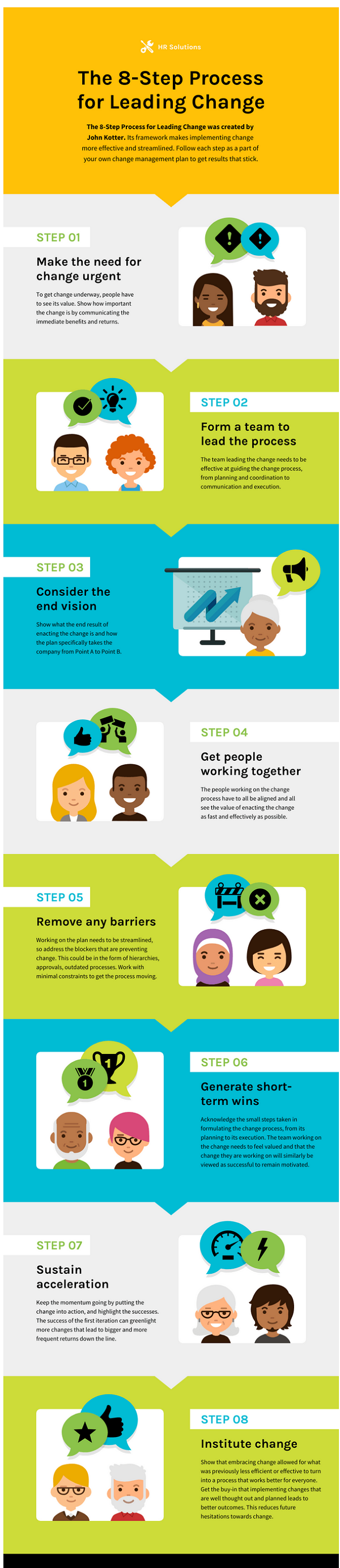
A variation of Kotter's steps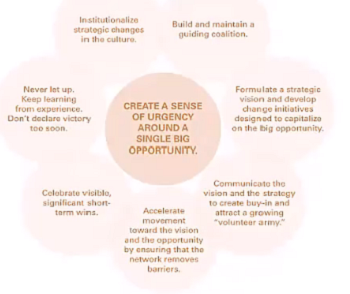
Grant Van Ulbrich, 2023
Upgrading of 8 Steps
Need to upgrade the 7 steps to handle the new environment; some upgrade suggestions include
- introducing laying the foundations for change, ie getting people psychologically ready to change, etc
- be aware that over developing a sense of urgency by, for example, suggesting a 'burning platform' scenario that can activate the survival response and trigger anxiety, guilt, anger, stress, panic, etc which are not productive for change)
- ensuring that members of the transitional team, to lead the change, can demonstrate their positive connections/networks, credibility, etc throughout the organisation and not be too elite and homogeneous or 'removed' from staff
- avoiding leadership from the top only that results in under-developed and under-communicated strategic vision; it is essential to achieve ownership of the change at lower levels of the organisation
- ensuring that management (especially middle management) is willing to cede control and do not act as blockers
- ensuring that short-term wins are sufficient to provide credibility and momentum
- declaring victory too soon, ie before the change is anchored in the organisation
- not realising the fragility of the new change and the need to institutionalise it in the organisation's systems and structures, etc.
- encouraging more creativity and innovation, ie exploring different ways of doing things; going beyond your job descriptions.
- nurturing a mindset that views technology as a lubricant for a better future rather than a threat.