
Brain (impact of AI)
Introduction
Below is a clear, research-based explanation of how AI affects the human brain and the implications for change management; it isespecially relevant for leaders and facilitators working in environments undergoing technological transformation.
1. How AI Affects the Human Brain
AI does not directly change the brain the way chemicals or trauma do, but it shapes cognitive processes, attention, decision-making, and neural pathways through repeated use. Three big domains matter most:
1.1 Cognitive Load & “Cognitive Offloading”
Humans naturally offload mental effort onto tools (e.g., writing, calculators. etc).
AI dramatically expands this:
Effects on the brain
- Reduces the need for long-term memory storage with brain now more reliant on external aids.
- Strengthens neural patterns related to information retrieval, prompting and judgement of outputs.
- Weakens neural patterns related to rote recall, manual problem-solving and sometimes attention to detail.
Risks
- Over-reliance can reduce “desirable difficulty” needed for deep learning.
- Shallow processing: the brain becomes more accustomed to “fast answers” than slow reflection.
Upside
- Frees working memory, enabling more creativity and synthesis.
1.2 Dopamine, Attention, and Reward Pathways
AI tools (especially generative tools) deliver:
- Instant gratification
- High novelty
- Low effort / high reward
Effects on neural pathways
- Reinforces short-loop dopamine cycles, ie preference for quick results.
- Reduces tolerance for ambiguity or slow tasks.
- Increases multitasking and “micro-dopamine addiction” (similar to social media but more productivity-oriented).
Implications
- People become more impatient with traditional processes.
- Change communication must compete with heightened novelty expectations.
1.3. Critical Thinking & Metacognition
Regular AI use improves:
- Ability to evaluate, critique and refine ideas
- Skills in orchestrating workflows (meta-skills)
But reduces:
- Independent idea generation (AI becomes the first draft)
- Persistence through complexity
The brain adapts by shifting from being the “creator” to the “curator”.
1.4. Social Cognition & Trust
Humans are hardwired to detect cues of intent, warmth, and competence from other humans.
AI lacks true intent, but the brain often interprets fluent output as authority.
Effects
- The “automation bias”: trusting machine output even when it is flawed.
- Reduced interpersonal interaction → weaker social neural circuits.
- Increased loneliness and deskilling in collaboration.
2. Implications for Change Management
AI affects people’s psychology and behaviour in ways that directly influence change initiatives. Below is a structured breakdown.
2.1 Increased Resistance Due to Cognitive Threat
AI threatens:
- Identity (“What is my role now?”)
- Competence (“Can I keep up?”)
- Autonomy (“Will I lose control over my work?”)
Because identity and competence are processed in the same networks as physical pain, this triggers:
- Amygdala activation
- Avoidance behaviours
- Defensive resistance
- “Surface compliance but deep refusal”
Change implication
Leaders must:
- Reduce perceived threat
- Emphasise augmentation, not replacement
- Provide safe pathways to experiment without judgment
2.2 Cognitive Overload & Change Fatigue Increase Faster
AI introduces:
- Rapid learning cycles
- Constant updates
- High novelty
The brain’s working memory saturates quickly, leading to:
- Confusion
- Overwhelm
- Avoidance
- Burnout
Change implication
Simplify. Drip-feed. Use just-in-time learning. Reduce simultaneous initiatives.
2.3 Need for New Skill Identities
People don’t fear AI; they fear losing status and relevance.
AI changes what “being competent” looks like, ie from technical expertise to AI-assisted problem solving, judgement and coordination.
Change implication
Change leaders must:
- Provide identity bridges (“You were great at X; here’s how that skill transfers”)
- Teach new meta-skills: prompting, verifying, synthesising
- Reward learning behaviour, not mastery
2.4 Faster Dopamine Cycles (this means impatience With Change Processes)
Because people now get:
- Instant answers
- Instant drafts
- Instant troubleshooting
They lose tolerance for:
- Long rollouts
- Slow decision processes
- Traditional training formats
Change implication
Deliver:
- Shorter learning modules
- Rapid pilots
- Instant feedback
- Visible quick wins
2.3 Automation Bias & Risk of Poor Decisions
People trust AI outputs—even wrong ones—because the brain prefers:
- Effort minimisation
- Cognitive shortcuts
Change implication
Build organisational “AI hygiene”:
- Verification protocols
- Bias checks
- Human-in-the-loop decisions
- Psychological safety to question outputs
2.6 Decline in Social Connection & Team Cohesion
AI reduces interaction frequency. The brain depends on:
- Mirror neurons
- Oxytocin circuits
- Interpersonal feedback for trust and cohesion.
Change implication
Leaders must intentionally:
- Create human connection moments
- Design collaborative rituals
- Reinforce team identity
3. What This Means for the Change Leader of the Future
A future-ready change leader must be skilled in:
3.1. Neuro-aware communication
- Reduce threat
- Increase meaning
- Provide certainty
- Reinforce autonomy
- Build connection
3.2 AI-augmented facilitation
- Using AI to prototype faster
- Helping teams test ideas safely
- Teaching verification skills
3.3 Curating—not delivering—knowledge
- Guiding people to formulate the right questions
- Translating AI insights into shared understanding
3.4 Navigating identity shifts
- Coaching individuals through role evolution
- Normalising discomfort
3.5. Designing for attention
- Using micro-learning
- Reducing noise
- Keeping instructions simple and intuitive
Summary
AI impacts the human brain by altering attention, memory, reward pathways, and decision-making processes, creating both opportunities and vulnerabilities. In change management, these neural shifts increase resistance, impatience, and cognitive overload, but also allow for faster innovation, creativity, and decision cycles when used well. Effective change leaders must understand these brain impacts in order to design communication, training, and engagement experiences that reduce threat, protect attention, reinforce identity, and build AI-augmented capability, ensuring people feel safe, valued, and able to adapt in a rapidly evolving environment.
Success Markers
Your organisation is ready for AI-enabled change when:
- People understand why AI is being introduced
- Team members feel safe, prepared, and valued
- Leaders communicate clearly and consistently
- AI use is supported by shared standards and guardrails
- Social cohesion is maintained or strengthened
- Staff demonstrate curiosity, experimentation and critical thinking
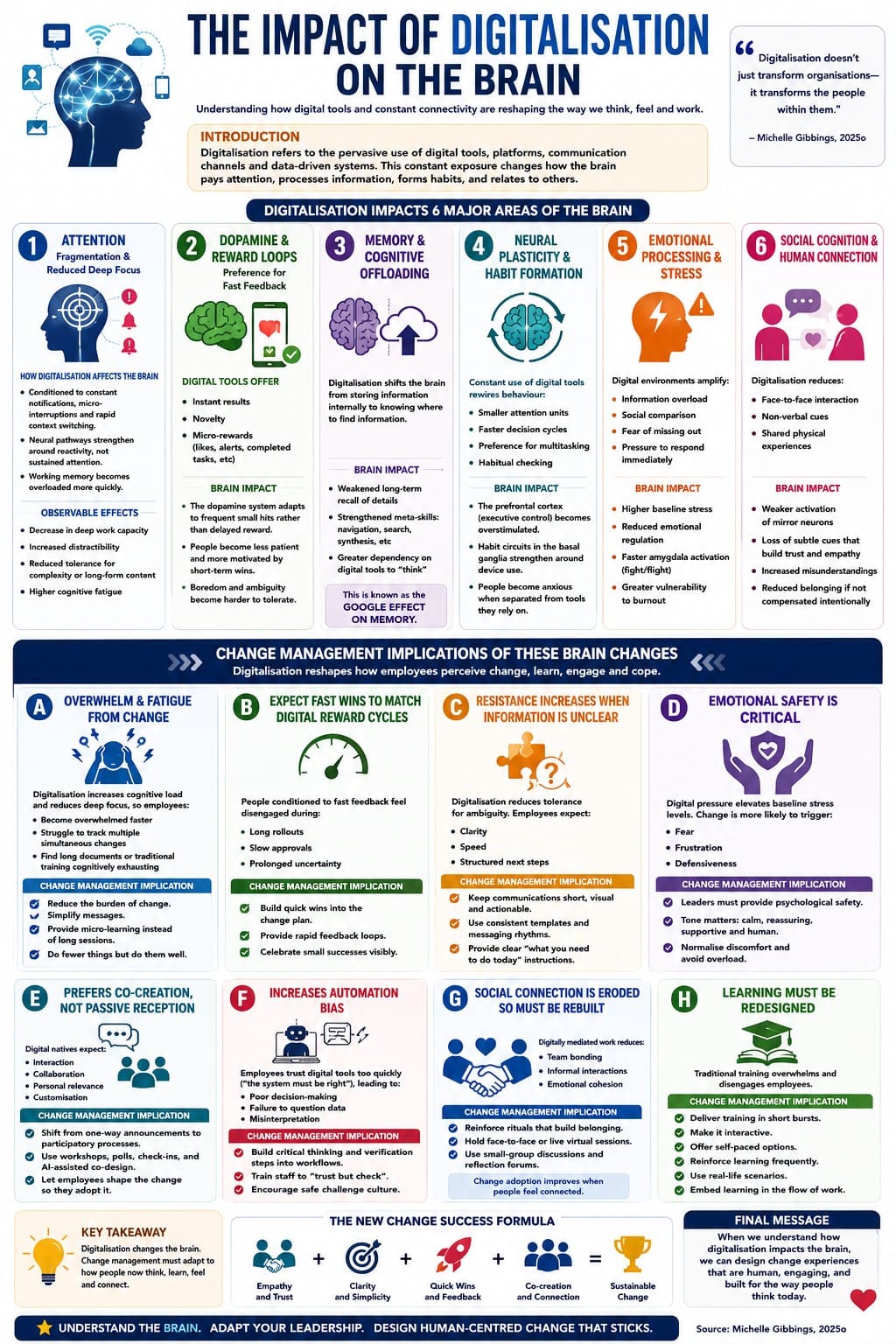
(main source: Michelle Gibbings, 2025o)