
Servant Leadership and Change Management
Servant-leadership behaviours can be readily linked to key change-management activities.
A. Vision and Case for Change
Servant-leader behaviour:
- Engages people in shaping the “why” of the change.
- Explains impacts honestly (both gains and losses).
Outcome: a more authentic, trusted case for change with stronger buy-in.
B. Communication During Change
Servant-leader behaviour:
- Listens deeply before speaking.
- Holds open forums, Q&A sessions, and drop-ins.
- Uses accessible language, not corporate jargon.
Outcome: people feel heard; thus, resistance drops and clarity increases.
C. Managing Resistance
Servant-leader behaviour:
- Seeks to understand root causes, eg fear, workload, identity threat, etc.
- Asks “What do you need to move forward?”
- Co-designs solutions with staff.
Outcome: resistance becomes a source of intelligence, not conflict.
D. Supporting Capability Building
Servant-leader behaviour:
- Prioritises training, coaching, and development.
- Protects time for learning.
- Recognises different learning speeds.
Outcome: people feel set up for success and better adoption of new ways of working.
E. Empathy in Times of Loss (as change involves loss)
Servant-leader behaviour:
- Validates emotions (fear, frustration, uncertainty, etc).
- Provides one-to-one check-ins.
- Uses restorative practices.
Outcome: faster emotional transition → less hidden resistance.
F. Empowerment and Engagement
Servant-leader behaviour:
- Gives staff meaningful influence over decisions.
- Shares control of processes and implementation.
- Encourages initiative.
Outcome: people shift from “victims of change” to co-owners of change.
G. Building Culture During Change
Servant-leader behaviour:
- Models the behaviours desired in the new culture.
- Celebrates contributions and milestones.
- Builds community and connection.
Outcome: the culture transforms with people, not to people; does not attempt to transform people in a coercive way
4. Benefits of Servant Leadership in Change Management
|
Benefit |
Explanation |
|
1. Higher trust |
Trust accelerates change and reduces friction. |
|
2. Better psychological safety |
People take more initiative in ‘safe’ environments. |
|
3. Stronger engagement |
People commit more when they feel valued. |
|
4. Reduced resistance |
Needs and concerns are identified early and handled respectfully. |
|
5. More sustainable change |
Change sticks because people own it. |
|
6. Healthier culture |
Collaboration increases; blame decreases |
Some Practical Servant Leader Behaviours for Change Leaders
- Ask: “What do you need from me?”
- Hold listening circles or yarning groups.
- Communicate early, often and honestly.
- Model vulnerability (“I don’t have all the answers, but we will work it out together”).
- Celebrate small wins.
- Coach individuals through transitions.
- Protect staff from unreasonable workloads.
- Involve staff in design, not just in rollout.
- Be visible, present, and approachable during change.
- Always prioritise well-being alongside performance.
Summary
Servant leadership in change management is about leading by serving, creating trust, supporting people through uncertainty, and empowering them to co-own the change so the transition is both compassionate and effective.
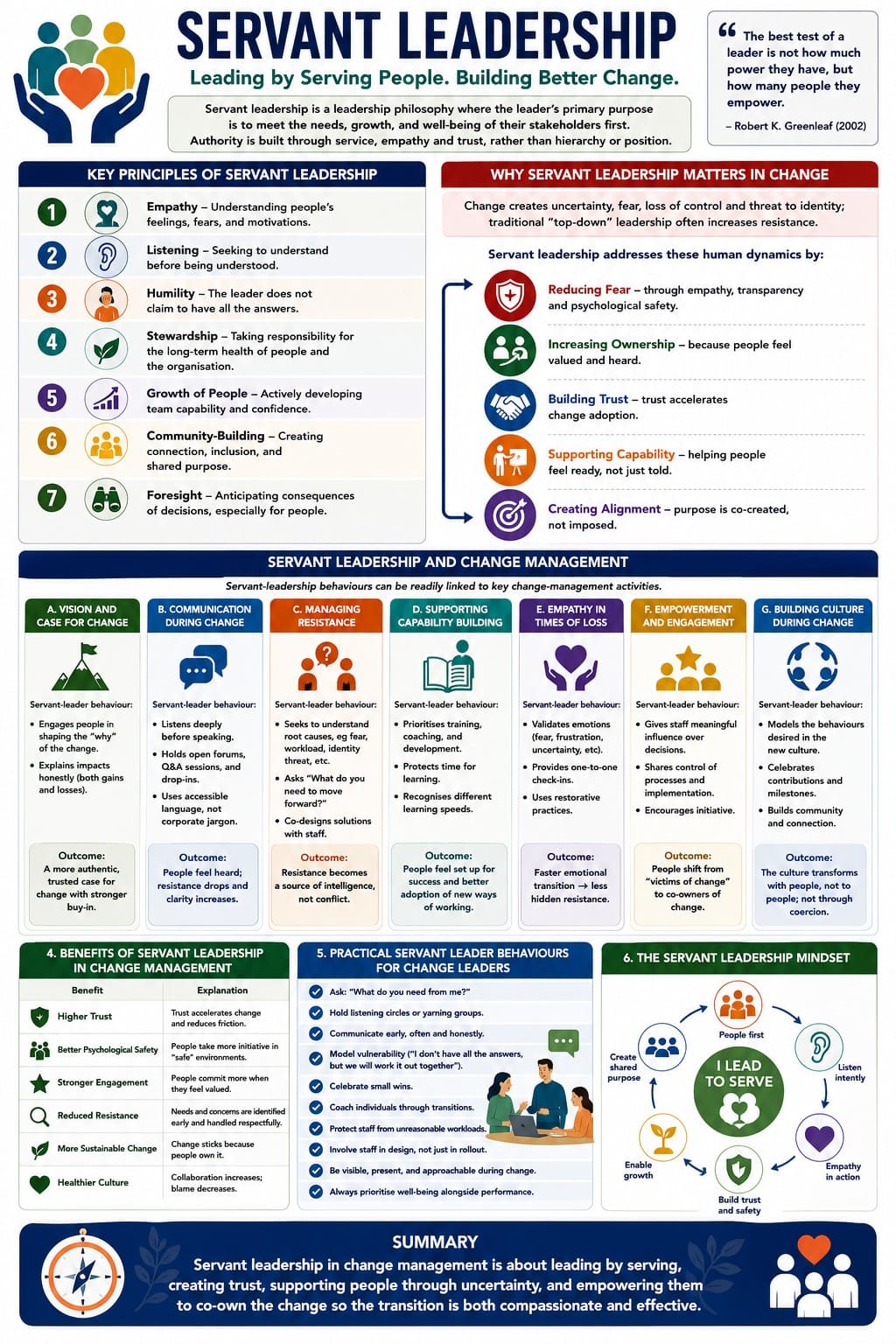
(main source: Robert K. Greenleaf, 2002)