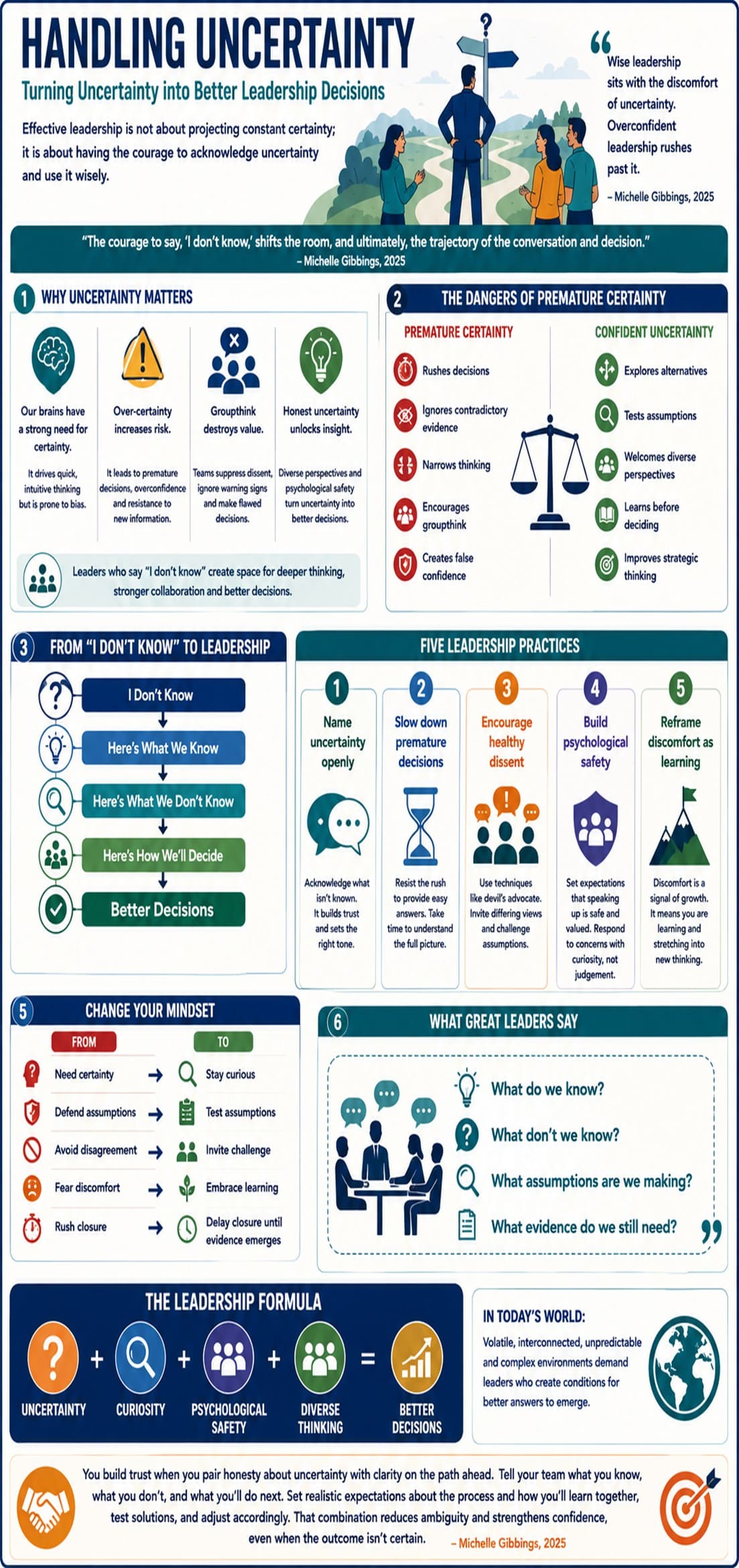
Handling Uncertainty
Introduction
Effective leadership is not about projecting constant certainty; it is about having the courage to acknowledge uncertainty and use it wisely.
“…wise leadership sits with the discomfort of uncertainty. Overconfident leadership rushes past it…”
Michelle Gibbings, 2025m
Leaders who say “I don’t know” create space for deeper thinking, better decisions and stronger collaboration, especially in complex and high-pressure situations.
“…The courage to say, "I don't know," shifts the room, and ultimately, the trajectory of the conversation and decision. The team pauses. They dig deeper into what they actually know and what they're assuming…”
Michelle Gibbings, 2025m
Psychological research shows that our brains have a strong need for certainty, which can lead to premature decisions, overconfidence and resistance to new information. Our fast, intuitive thinking favours easy answers but is prone to bias. In leadership, this bias is reinforced by western social expectations to always appear confident and decisive.
Over-certainty increases the risk of groupthink, where teams suppress dissent, ignore warning signs and make flawed decisions.
Leaders, driven by a high need for closure, tend to lock into familiar solutions, narrow their thinking and dismiss contradictory data; this approach undermines strategic quality over time.
“…When someone has a high need for closure, they crave firm answers and clear-cut judgments. Uncertainty feels uncomfortable, even threatening. They'll seize on the first plausible solution and freeze on it, even when fresh evidence suggests a different path forward. It's a pattern that can derail strategic thinking, stifle innovation and limit your ability to navigate complexity with wisdom.
Additionally, when you experience uncertainty as threatening, you are more prone to anxiety, indecisiveness or an overreliance on behaviours that make you feel safe, such as delaying decisions or clinging to familiar options, even when those options are sub-optimal.
Put simply: our brains like the cognitive ease of the well-trodden path……highlight the downside of premature closure. Leaders who are strongly driven by the need for closure are more likely to favour simple, familiar solutions, minimise ambiguity and sideline information that complicates the story they want to tell. They rely heavily on cognitive shortcuts rather than exploring alternatives, conduct narrower information searches, and quickly lock in initial judgments, even when new data suggests pursuing alternative options.
In fast-moving contexts, that pattern can feel reassuring in the short term while quietly eroding decision quality…”
Michelle Gibbings, 2025m
Discomfort and uncertainty, however, are not threats; they are signals of learning. Diverse teams often feel less confident but make better decisions when psychological safety is present.
When leaders combine diversity of perspective with a culture where people feel safe to speak up, uncertainty becomes a source of insight rather than anxiety.
Research on authentic leadership shows that credibility is strengthened, not weakened, when leaders are honest about what they do and don’t know, while still providing clarity on purpose, next steps and decision processes. The difference lies between:
- Abdicating leadership (“I have no idea”), and
- Leading with confident uncertainty (“Here’s what we know, what we don’t, and how we’ll decide”).
Practical leadership practices include:
- Naming uncertainty openly and explicitly
- Slowing down rush to provide an obvious answer:
“…Being explicit about the context helps the team identify that the situation warrants slower, more deliberate thinking, even under high pressure…”
Michelle Gibbings, 2025m
- Encouraging dissent, not just agreement by using techniques like devil’s advocate, etc; actively discouraging groupthink; encouraging differing views, ideas and perspectives
- Actively building psychological safety
“…Set expectations that thoughtful challenge is part of each person's role, not a career risk. Respond to bad news with curiosity before judgement. When someone raises a concern that creates discomfort, thank them first, then explore it. Over time, this signals that speaking up about uncertainty is not only safe but valued…”
Michelle Gibbings, 2025m
- Reframing discomfort as a growth signal
“…When a new idea, piece of data or dissenting view makes you uncomfortable, notice that reaction and treat it as a prompt to dig deeper. Consider what you might be learning and what assumptions are being challenged. From a development perspective, learning sits at the edge of your comfort zone. That uneasy feeling is often the indicator that you are stretching into new learning territory…”
Michelle Gibbings, 2025m
Summary
In today’s volatile, interconnected, unpredictable and complex environment, clinging to certainty is risky.
The most influential leaders focus less on having the right answers and more on creating the conditions in which better answers can emerge. Doubt may remain uncomfortable—but it is one of a leader’s most powerful tools.
“…You build trust when you pair honesty about uncertainty with clarity on the path ahead. Tell your team what you know, what you don't, and what you'll do next. Set realistic expectations about the process and how you'll learn together, test solutions, and adjust accordingly.
That combination of transparency and clear direction reduces ambiguity and strengthens confidence, even when the outcome isn't certain…”
Michelle Gibbings, 2025m
(main source: Michelle Gibbings, 2025m)