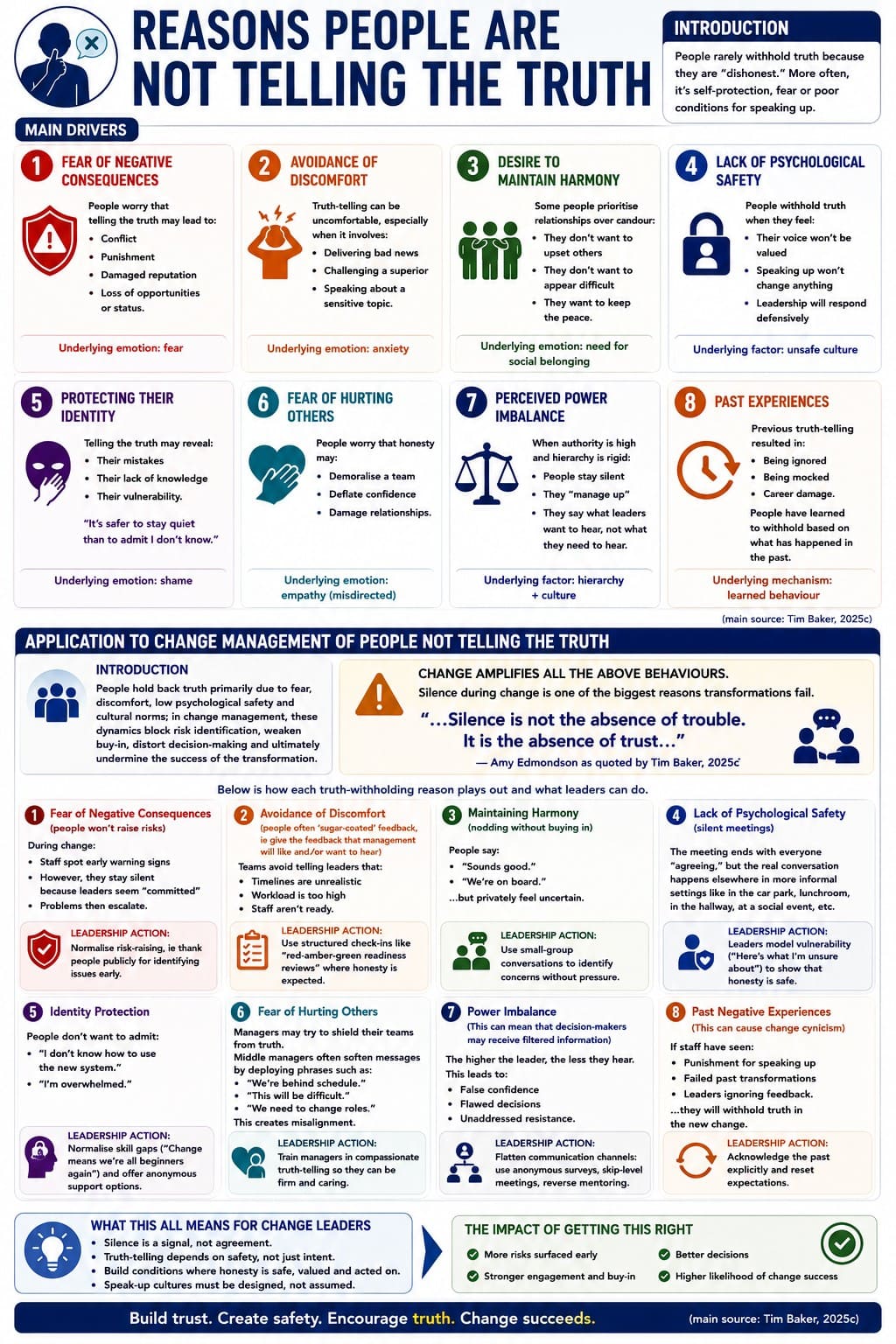
Application to Change Management of People not Telling the Truth
Introduction
People hold back truth primarily due to fear, discomfort, low psychological safety and cultural norms; in change management, these dynamics block risk identification, weaken buy-in, distort decision-making and ultimately undermine the success of the transformation.
Change amplifies all the above behaviours.
Silence during change is one of the biggest reasons transformations fail.
"…Silence is not the absence of trouble. It is the absence of trust…"
Amy Edmondson as quoted by Tim Baker, 2025c.
Below is how each truth-withholding reason plays out and what leaders can do.
1. Fear of Negative Consequences (people won’t raise risks)
During change:
- Staff spot early warning signs
- However, they stay silent because leaders seem “committed”
- Problems then escalate.
Leadership action:
Normalize risk-raising, ie thank people publicly for identifying issues early.
2. Avoidance of Discomfort (people often ‘sugar-coated’ feedback, ie give the feedback that management will like and/or want to hear)
Teams avoid telling leaders that:
- Timelines are unrealistic
- Workload is too high
- Staff aren’t ready.
Leadership action:
Use structured check-ins like “red-amber-green readiness reviews” where honesty is expected.
3. Maintaining Harmony (nodding without buying in)
People say:
- “Sounds good.”
- “We’re on board.”
…but privately feel uncertain.
Leadership action:
Use small-group conversations to identify concerns without pressure.
4. Lack of Psychological Safety (silent meetings)
The meeting ends with everyone “agreeing,” but the real conversation happens elsewhere in more informal settings like in the car park, lunchroom, in the hallway, at a social event, etc
Leadership action:
Leaders model vulnerability (“Here’s what I’m unsure about”) to show that honesty is safe.
5. Identity Protection
Leaders and staff hide negatives, limitations, concerns, etc
People don’t want to admit:
- “I don’t know how to use the new system.”
- “I’m overwhelmed.”
Leadership action:
Normalise skill gaps (“Change means we’re all beginners again”) and offer anonymous support options.
6. Fear of Hurting Others
Managers may try to shield their teams from truth.
Middle managers often soften messages by deploying phrases such as:
- “We’re behind schedule.”
- “This will be difficult.”
- “We need to change roles.”
This creates misalignment.
Leadership action:
Train managers in compassionate truth-telling so they can be firm and caring.
7. Power Imbalance
This can mean that decision-makers may receive filtered information
The higher the leader, the less they hear.
This leads to:
- False confidence
- Flawed decisions
- Unaddressed resistance.
Leadership action:
Flatten communication channels: use anonymous surveys, skip-level meetings, reverse mentoring.
8. Past Negative Experiences
This can cause change cynicism if staff have seen:
- Punishment for speaking up
- Failed past transformations
- Leaders ignoring feedback.
…they will withhold truth in the new change.
Leadership action:
Acknowledge the past explicitly and reset expectations.
(main source: Tim Baker, 2025c)