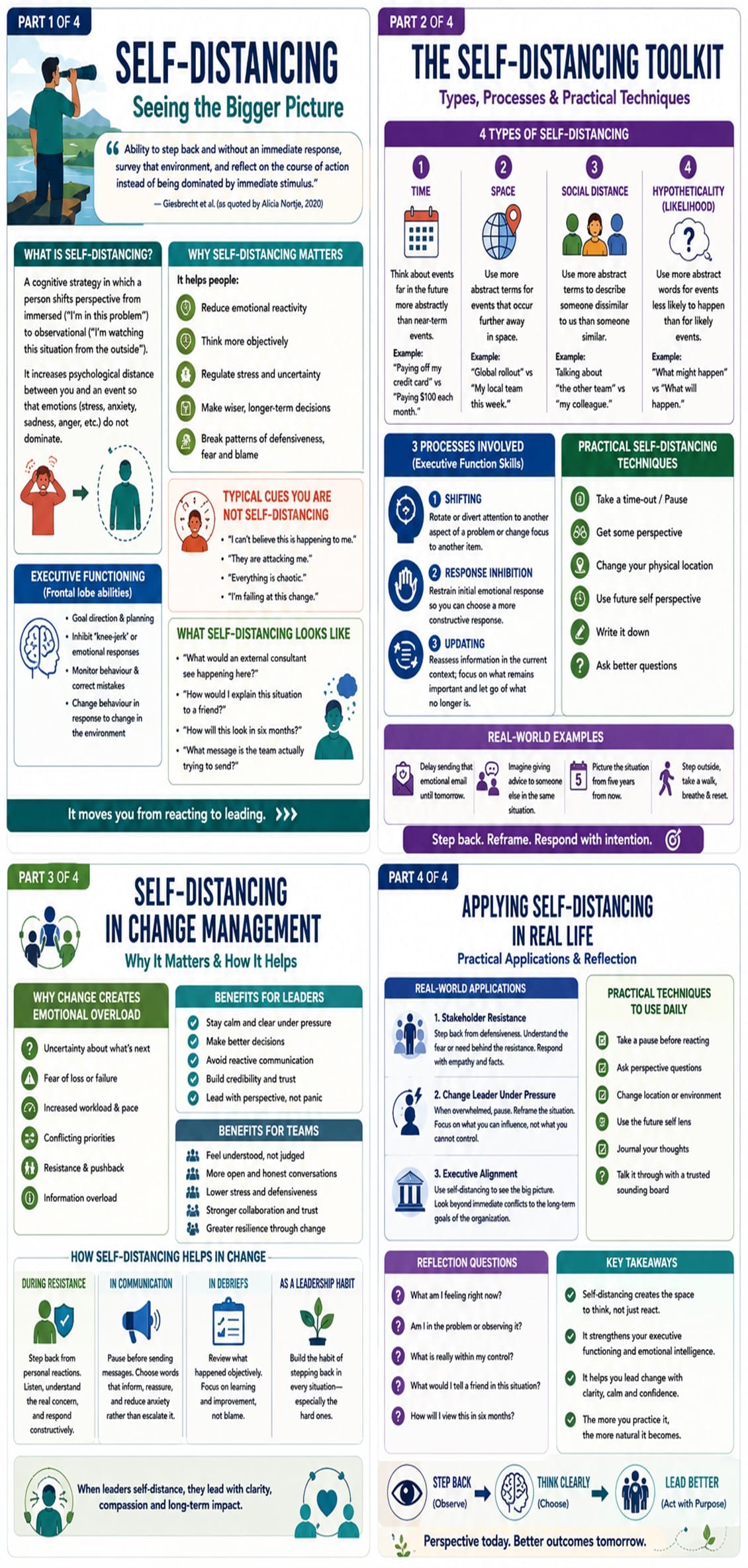
Self-Distancing Change Management Checklist
This process is structured around the key moments in a change initiative where self-distancing has the greatest impact.
1. Before Making Decisions
Use when evaluating options, setting direction or responding to ambiguity.
Perspective Shift
- Have I viewed the situation from a third-person perspective?
- If I were an external consultant, what would I recommend?
- What would future-me think of this decision?
- How would I explain this situation to a colleague not involved?
Bias & Emotion Check
- Which parts of my reaction are emotional rather than factual?
- Am I reacting from fear, ego, threat, or pressure?
- What assumptions am I making that may not be accurate?
- What alternative interpretations could be equally valid?
2. When Managing Resistance
Use during stakeholder concerns, pushback or conflict.
Understanding the Other Side
- Have I tried to see this from the other person’s viewpoint?
- If I were observing their behaviour, what patterns would I notice?
- What underlying fear or need might be driving their resistance?
- What would a documentary narrator say is really happening here?
Reframing the Issue
- What is the real issue behind the surface complaint?
- How would an outsider frame the resistance?
- What part of their behaviour is not about me or the project?
3. When Communicating Change
Use before sending messages, holding town hall meetings or managing expectations.
Audience Lens
- Have I read this message as if I were receiving it for the first time?
- What unintended interpretations might occur?
- How would a neutral third party rewrite this message for clarity?
- What assumptions am I making that employees do not share?
Tone & Clarity Check
- Is the communication empathetic and non-defensive?
- Does it acknowledge uncertainty realistically?
- Does it focus on shared goals rather than organisational pressure?
4. During High-Stress Moments
Use during crises, deadlines, conflict or rapid changes.
Emotional Regulation
- Have I taken a moment to step back from the situation?
- How would I describe this moment if I wasn’t directly involved?
- What story will this moment tell in six months?
- What would the calmest version of me advise right now?
Problem Clarity
- What would an outsider identify as the core issue?
- What is noise vs. what is signal?
- What is the simplest explanation for what’s happening?
5. In Change Reviews, Lessons Learnt and Debriefs
Use at the end of phases, sprints, releases, or after setbacks.
Balcony View Review
- If we watched this change from the balcony, what patterns would we see?
- What helped us move forward?
- What slowed us down?
- What would a case-study writer say about our team?
Constructive Interpretation
- Are we evaluating behaviours, not blaming people?
- Have we separated facts from narratives?
- What insights become obvious only when taking a distanced perspective?
6. Personal Leadership Practice
Use weekly or after key interactions.
Self-Reflection
- What situation did I become too immersed in this week?
- Where could I have used self-distancing to stay calmer or clearer?
- What would future-me thank me for doing differently?
- What patterns in my leadership become clearer when I step back?
(main source: Alicia Nortje, 2020)