
Application to Change Management of False Beliefs about Emotions
Introduction
Identifying false beliefs about emotions is a core capability for modern change leaders. It improves communication, reduces resistance and accelerates alignment.
Some Key Applications:
1. Reduces Resistance by Making Emotions Discussable
Change fails when leaders ignore the emotional layer.
By challenging beliefs like “emotions aren’t relevant at work”, leaders create space for:
- naming fears without judgement
- exploring loss during transition
- voicing hopes and concerns
- explicitly identifying emotional blockers earlier
This reduces secrecy, rumour-driven resistance and hidden objections.
2. Helps Leaders Interpret Emotional Signals Accurately
If leaders assume “anger = difficult person”, they miss what anger may instead signal:
- perceived unfairness
- lack of autonomy
- workload overload
- confusion.
Identifying false beliefs enables leaders to see emotions as data, not disruption.
3. Builds Psychological Safety
When employees believe emotions are punished or unwelcome, they stay silent.
Correct beliefs: emotions are valid, while behaviour is what we regulate; we can thereforeincrease psychological safety, improving:
- innovation
- difficult conversations
- early risk identification
- more honest feedback loops.
4. Leads to Better Decision-Making
False belief: Decisions must be logic-only.
Correct belief: emotions highlight risks, values and commitments.
Leaders who integrate emotional insight make decisions that reflect the human impact of change and lead to better adoption.
5. Supports More Effective Communication
When leaders recognise emotions as integral, they communicate with:
- empathy
- context
- clarity
- apt pacing
This radically improves message reception, especially during high-uncertainty periods.
6. Enhances Change Readiness Assessments
Change-readiness tools often fail because they measure only structural factors.
Correcting false beliefs about emotions allows leaders to assess:
- emotional capacity
- unspoken anxieties
- group morale
- levels of trust
- emotional energy available for change.
This leads to more accurate readiness judgments.
7. Prevents Emotional Contagion and Escalation
False belief: my emotions don’t affect others.
Reality: emotions spread rapidly.
Identifying this helps leaders:
- manage their own emotional tone
- avoid transmitting stress
- stabilise teams during uncertainty.
8. Improves Coaching and Mentoring During Change
Leaders who recognise emotional false beliefs can coach team members to:
- separate emotion from fact
- reframe fear into curiosity
- convert frustration into problem-solving
- build tolerance for ambiguity.
This increases individual adaptability.
Summary
Identifying false beliefs about emotions enables leaders to treat emotions as useful information rather than noise, resulting in more resilient, honest and high-performing teams during organisational change.
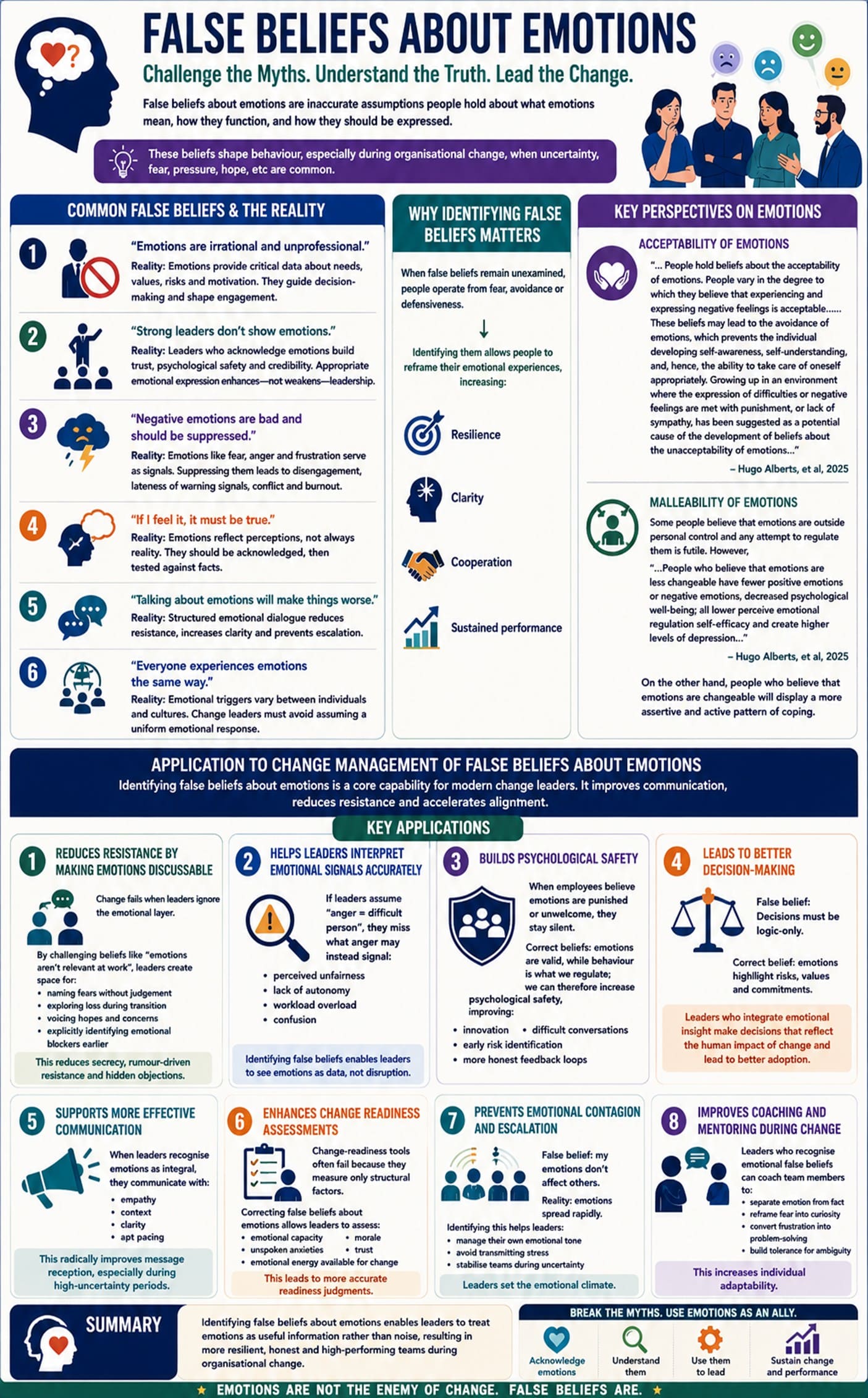
(main source: Hugo Alberts et al, 2025)