
More on the Bull’s-Eye Values Survey (BEVS)
Introduction
BEVS is a self-reflection tool that helps people see:
What they value most (their principles, what matters, how they want to behave) and
How closely their current actions match those values.
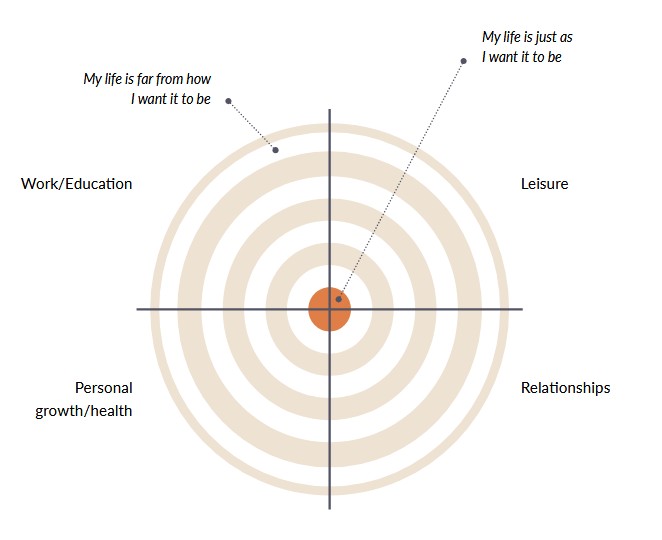
It uses a target (bull’s-eye) diagram with 4 life areas:
Work/Education
Relationships
Personal Growth/Health
Leisure
People mark an X in each quadrant to show how “on track” or “off-track” they feel in living their values.
Closer to the centre = more aligned with values.
Further away = less aligned.
The result is a visual map of value–behaviour alignment.
Why It Exists
Most people know what matters to them, but day-to-day pressures cause them to drift.
The BEVS:
- Makes values visible
- Helps people notice gaps
- Encourages small actions to get “closer to the bull’s-eye”
- Builds personal responsibility for behaviour
It comes from Acceptance and Commitment Therapy (ACT) and is widely used in coaching, leadership and wellbeing.
How It Applies to Change Management
Organisational change often triggers:
- Uncertainty
- Avoidance
- Inconsistent behaviour
- Temporary compliance instead of genuine commitment
The Bull’s-Eye Values Survey helps by reconnecting people to their core values, which are more stable than goals, policies or roles.
How it works in a change context:
1. Clarifies Why People React to Change
If someone values stability, they may resist uncertainty.
If someone values learning, they will embrace new systems.
BEVS helps explain these reactions without judgement.
This gives leaders deeper insight into human barriers to change.
2. Encourages Personal Accountability
Instead of “the organisation must change me”, the survey leads people to ask:
“How do my values guide my behaviour during change?”
“What small actions would move me closer to who I want to be at work?”
This shifts people from resistance to ownership.
3. Turns Values into Practical Change Behaviours
After completing the BEVS, people identify specific next steps:
Examples:
- “Be more open with colleagues about challenges during the transition.”
- “Set aside one hour weekly to learn the new system.”
- “Give constructive feedback instead of withholding concerns.”
These small, values-aligned steps accelerate behaviour change.
4. Links Personal Values to Organisational Change Goals
You can overlay organisational values or change principles with what people personally value.
For example:
- Personal value: Integrity
- Organisational change value: Transparency
- Aligned behaviour: “Share concerns early, rather than after decisions are made.”
This creates shared purpose and a stronger case for change.
5. Builds Emotional Resilience
ACT principles teach that:
- Values keep people steady
- Emotions fluctuate
- Behaviour aligned with values improves resilience
During major organisational change, employees who act according to values cope better with:
- Ambiguity
- Setbacks
- Stress
- Temporary discomfort
6. Helps Leaders Model the Right Behaviours
Leaders can complete the BEVS to identify where they may be drifting from their own values under pressure.
Example:
Value: Fairness
Current behaviour: giving limited time to staff because of workload
This awareness helps leaders course-correct and align behaviour with the change they want to lead.
In Summary
The Bull’s-Eye Values Survey:
- Identifies what matters most
- Shows how aligned, or not, behaviour is
- Reveals drift caused by stress or change
- Encourages small, actionable improvements
- Improves personal responsibility
- Strengthens engagement and commitment
- Helps people navigate change with clarity and resilience
It is a powerful bridge between personal meaning and organisational transformation.