
Framework 209 Upgraded Nilakant & Ramnarayan’s Framework
Introduction
The framework aims to:
- Analyze how change management is practised in organizations.
- Identify the necessary steps organizations must take to implement effective change.
- Help managers and business owners better manage change to achieve business objectives.
Core Concepts
This framework builds on the Nilakant & Ramnarayan’s framework with its 4 key change tasks:
-
Appreciating Change – Understanding the need for change.
-
Mobilizing Support – Engaging stakeholders and building commitment.
-
Executing Change – Implementing changes effectively.
-
Building Change Capability – Developing long-term adaptability within the organization.
In addition, it emphasizes emotional, cognitive, spiritual and behavioural dimensions of change; highlights the importance of leadership in driving change.
Methodology
- The research uses qualitative methods, including literature review and analysis of secondary data.
- Focuses on theoretical application rather than empirical case studies.
Key Findings
- Change is necessary due to external forces like globalization, competition and technology.
- Successful change depends on:
- Clear vision and appreciation for the need to change.
- Strong leadership that can mobilize and align people.
- Structured execution strategies.
- Long-term investment in building internal change capacity.
- Many failures in change efforts stem from lack of readiness and poor stakeholder engagement.
Four Key Change Elements
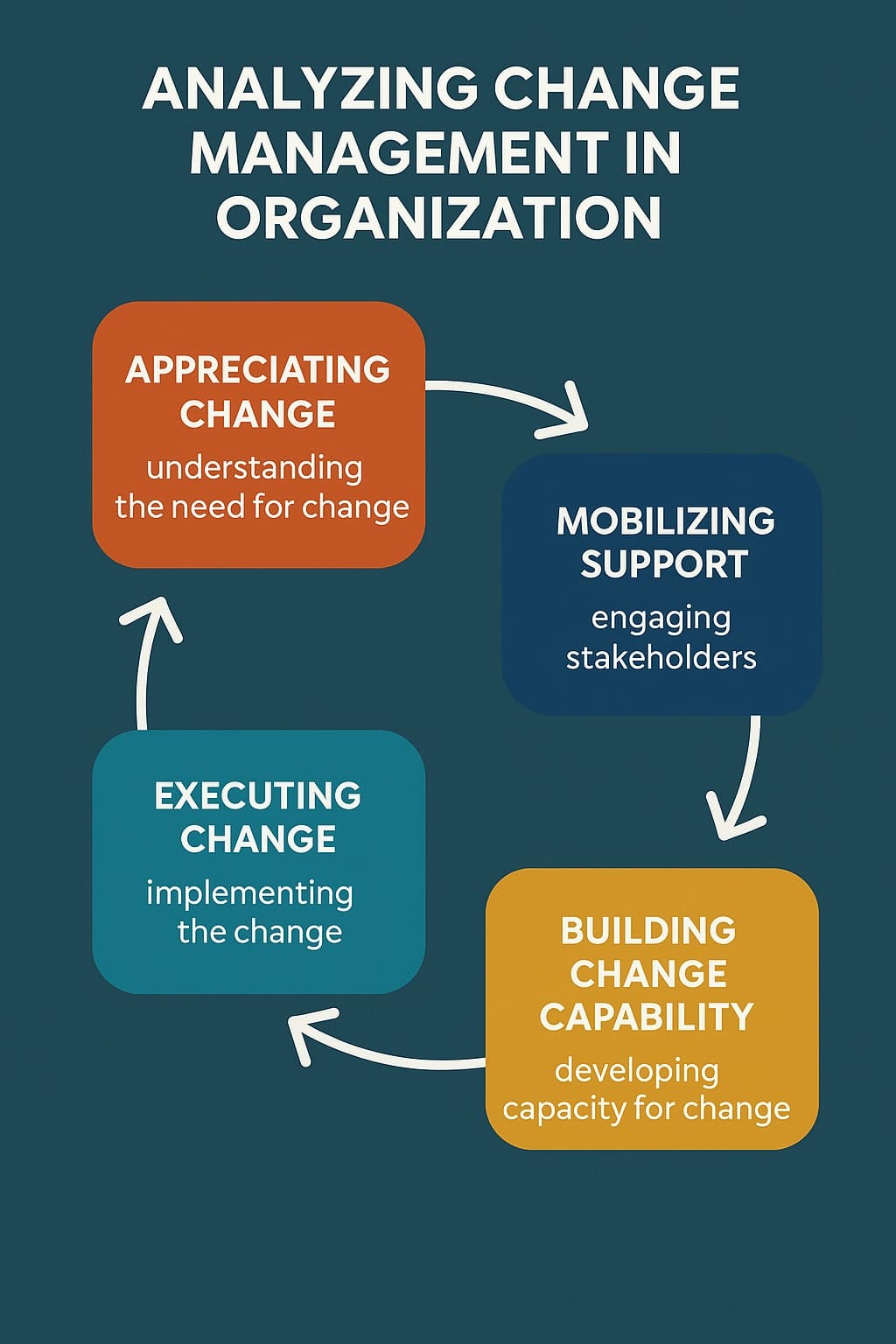
(source: Nilakant et al, 2006)
Four Key Elements for Successful Change
1. Appreciating Change
Goal: Understand and communicate the need for change.
- Assess external/internal drivers: consider market shifts, competition, regulations, internal inefficiencies.
- Build awareness and urgency: help the organization see why change is necessary.
- Acknowledge emotions: recognize that change provokes anxiety and resistance; empathy is crucial.
- Avoid denial: denial is a key obstacle to timely adaptation.
Mindset Shift: from complacency to awareness.
2. Mobilizing Support
Goal: Secure commitment and participation from key stakeholders.
- Create a guiding coalition: engage influential individuals who support the change.
- Use dialogue and participation: invite people into the conversation, increasing ownership.
- Align values and interests: make the case in ways that resonate with different groups.
- Build trust: transparent communication is critical.
Mindset Shift: From skepticism to ownership.
3. Executing Change
Goal: Implement the change effectively and sustainably.
- Pilot and scale: start small, learn and expand.
- Address structural and cultural barriers: align systems, processes and behaviours with the change.
- Manage resistance: understand the root causes and respond constructively.
- Provide resources and training: equip people with what they need to succeed.
Mindset Shift: from confusion to clarity and action.
4. Building Change Capability
Goal: Enable the organization to adapt continuously.
- Foster a learning culture: encourage experimentation and learning from failure.
- Develop internal leaders: build capacity at all levels for leading future change.
- Institutionalize change processes: make adaptation part of business as usual.
- Monitor and reflect: use feedback loops and data to inform future efforts.
Mindset Shift: from fragility to resilience.
Key Concepts & Insights
1. Mindsets Drive Behaviour
- Mindsets shape how people interpret situations and respond to them.
- Change must address cognitive, emotional and relational dimensions—not just technical.
2. Resistance is Natural
- Resistance comes from fear, loss and uncertainty.
- It should be managed through empathy, inclusion and communication—not confrontation.
3. Change as a Learning Process
- Leaders must enable learning at all levels.
- Mistakes are part of progress—encourage experimentation and sense-making.
4. Context is Crucial
- Change strategies must fit organizational culture, national culture and industry context.
- Global organizations must navigate cross-cultural sensitivities.
Mindset Shifts Required
| From | To |
|---|---|
| 1. Control | Collaboration |
| 2. Top-down mandates | Participative engagement |
| 3. Certainty & rigidity | Adaptability & learning |
| 4. Compliance | Commitment |
Role of Leadership
- Leaders are not just change implementers; they are sense-makers and mindset shapers.
- Authenticity, openness and the ability to navigate ambiguity are essential.
Summary
- Effective change management is a structured, people-cantred process.
- It requires both strategic planning and emotional intelligence.
- Organizations that prioritize communication, leadership and adaptability are better equipped to manage change.
- Sequence
Awareness ➜ Engagement ➜ Implementation ➜ Institutionalization
(Appreciating ( Mobilizing (Executing (Building
Change) Support) Change) Capability)
- Change efforts often fail because they focus on systems and structures, while ignoring people’s mindsets. Sustainable change requires altering mindsets, such as the underlying assumptions, values and beliefs that drive behaviour.
- Four Key Change Tasks
-
Appreciating Change: acknowledging the need for change and its implications.
-
Mobilizing Support: building commitment through dialogue, trust and shared understanding.
-
Executing Change: making the change real with structure, resources and action.
-
Building Change Capability: developing long-term adaptability and resilience.
-
(main source: V. Nilakant et al, 2006)