
Curiosity Curve (part of creativity)
Introduction
Curiosity is an important part of creativity and imagination. Consequently, it plays a significant role in change management as it can encourage engagement, buy-in, etc.
An element of curiosity is the Curiosity Curve.
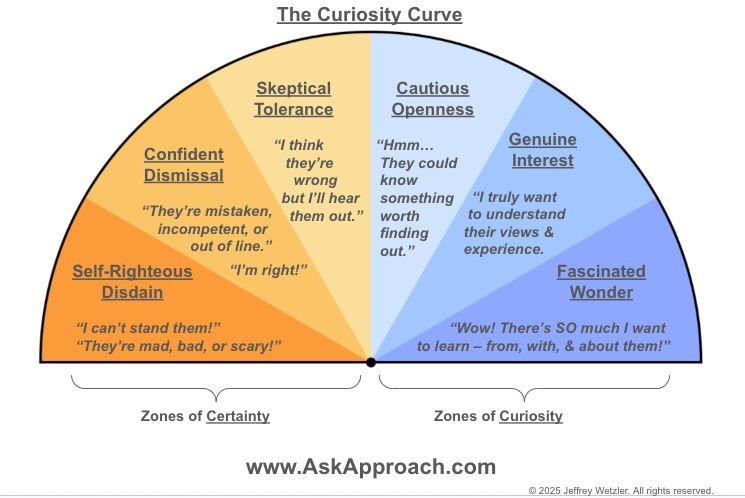
The curiosity curve is a storytelling and communication strategy used to maintain and build interest over time by creating anticipation, mystery or tension. It's commonly used in writing, filmmaking, marketing, speeches, education and facilitation to engage an audience and keep them wanting more.
What is the Curiosity Curve?
At its core, the curiosity curve involves raising a question or mystery early on and then delaying the answer or resolution in order to keep people engaged. The emotional and cognitive tension compels the audience to stick around to find out what happens next.
Typical Structure of a Curiosity Curve
- Hook, ie to incite curiosity (introduce a compelling question, problem or surprising fact; this stimulates the audience's desire to resolve their uncertainty.)
- Build-Up and Sustain Curiosity (provide partial information or tease answers, adding tension or stakes; avoid giving away the resolution too early.)
- Reveal or Payoff to satisfy curiosity (finally, deliver the answer, insight or twist; the timing here is key—it should feel satisfying, not rushed or dragged out.)
Why It Works (Psychology)
- Information Gap Theory (when people notice a gap between what they know and what they want to know, it creates discomfort, which they are motivated to resolve.)
- Zeigarnik Effect (people remember uncompleted or interrupted tasks - like unanswered questions - better than completed ones.)
Some Examples
- Storytelling (a novel begins with a mysterious death—who did it and why? The answer is revealed only after several chapters of clues.)
- Education (a teacher asks, “What would happen if gravity suddenly disappeared?” before launching into a physics lesson.)
- Marketing (a headline reads: “You’re brushing your teeth wrong. Here’s why.” You click to find out.)
- Facilitation (a facilitator opens a workshop with a provocative scenario, then uses activities to explore the answer gradually.)
How to Use It Effectively
- Start with a clear, relevant question or puzzle.
- Avoid giving away the answer too soon.
- Layer tension, stakes or emotion to deepen interest.
- Ensure the payoff is worth the wait—it should be surprising or insightful.
(main source: Jeff Wetzler, 2025)