
Reframing as Part of Mindset
Introduction
Reframing is a powerful technique that involves shifting the way people perceive a situation, challenge or opportunity. Instead of changing the facts, reframing changes the meaning people attach to those facts—thereby opening up new possibilities for thought, dialogue and action.
Reframing is defined as the process of changing the perspective through which a situation is viewed, in order to encourage more constructive understanding and action.
NB Reframing is not spin. It's important to be authentic. Reframing should not mislead or manipulate; it should clarify, expand understanding and foster trust.
Why Reframing Matters in Change Management:
- Breaks resistance by helping people see change in a more positive or less threatening way.
- Encourages creativity by challenging existing mental models.
- Promotes alignment by creating shared meaning and language.
- Shifts mindset from fixed or defensive to open and growth-oriented.
Examples of Reframing in Change Management:
|
Old Frame (Limiting) |
Reframed Perspective (Empowering) |
|
“This change is a threat.” |
“This change is a chance to grow and learn.” |
|
“We’re losing control.” |
“We’re gaining new ways to adapt and thrive.” |
|
“We’re being forced to change.” |
“We’re being invited to lead the future.” |
|
“This is too risky.” |
“This is an opportunity to innovate.” |
How to Apply Reframing
- Listen for limiting narratives (pay attention to language that reflects fear, resistance, or fixed mindsets.)
- Identify the underlying assumptions (what belief is driving that narrative?)
- Introduce a new lens (use metaphors, stories, data or analogies to change the perspective.)
- Invite participation (ask, “What if we looked at it this way?” to co-create meaning.)
- Repeat and reinforce (reframing must be consistently supported in communication, leadership behaviours and team dialogue.)
Cognitive Reframing vs Strategic Reframing:
|
Type |
Focus |
Example |
|
Cognitive Reframing |
Changing individual mindset |
“Instead of fearing failure, see it as feedback.” |
|
Strategic Reframing |
Changing organisational positioning |
“We’re not cutting costs—we’re redirecting resources.” |
Notable Theories and Influences:
- Bolman & Deal’s Four Frames (structural, human resource, political and symbolic frames.)
- Neuroscience of Change (people resist change when their threat response is activated. Reframing reduces perceived threat.)
- Transformational Leadership (leaders often reframe problems to inspire a higher purpose or vision.)
Reframing Matrix
- Draw a simple 4-square grid (leaving a space to name the problem or issue that needs exploring)
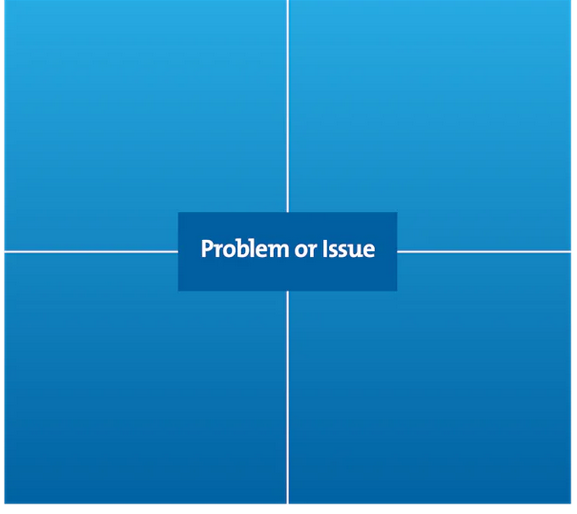
- Using the 4-phase approach to identify forward different perspectives, ie
i) product perspective
"...Is there something wrong with the product or service? Is it priced correctly? How well does it serve the market? Is it reliable?..."
Mindtool Contact Team, 2025d
ii) planning perspective
"...Are your business plans, marketing plans, or strategy at fault? Could we improve them?..."
Mindtool Contact Team, 2025d
iii) potential perspective
“…how can we increase sales, or productivity? If we were to seriously increase our targets, or our production volumes, what effect would it have on the problem?..."
Mindtool Contact Team, 2025d
iv) people perspective
"... What are the people impacts and people implications of the problem? What do people involved with the problem think? Why are potential customers not using or buying a product..."
Mindtool Contact Team, 2025d
Alternatively, look at the problem from the perspectives from different stakeholders’ points of view.
- Use brainstorming to break the habitual modes of thinking, eg Edward DeBono's creative thinking techniques like 6 thinking hats, fan concept, Po, random word, etc
(for more details, see elsewhere in the Knowledge Base)
Example of Reframing Matrix, eg new product not selling well
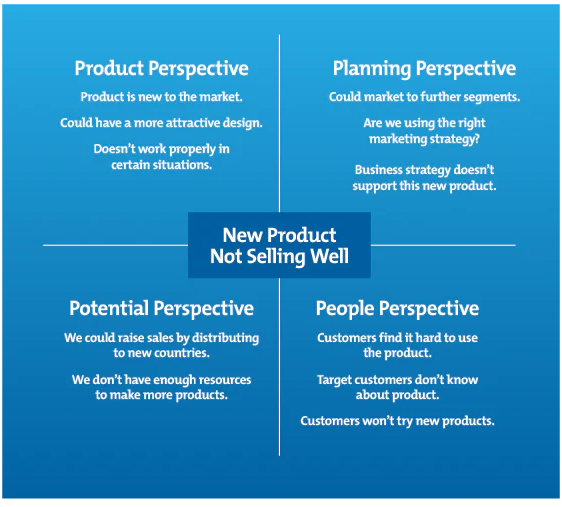
(source: Mindtool Contact Team, 2025d)