
Another Way to Look at Evaluating Success and Failure Factors
Introduction
Using a fishbone approach to look at resistance and short-term factors.
It is a graphical technique to identify, analyse and display the relationships.
(to see more detail, visit other parts of the Knowledge Base)
There are four steps involved
- i) problem needs to be identified
- ii) then the main category of causes needs to be considered under the headings of policy, place/environment, people and procedures
iii) identify the possible factors impacting the focus event
- iv) once identified and analysed, corrective actions may be developed.
Three examples:
- Resistance
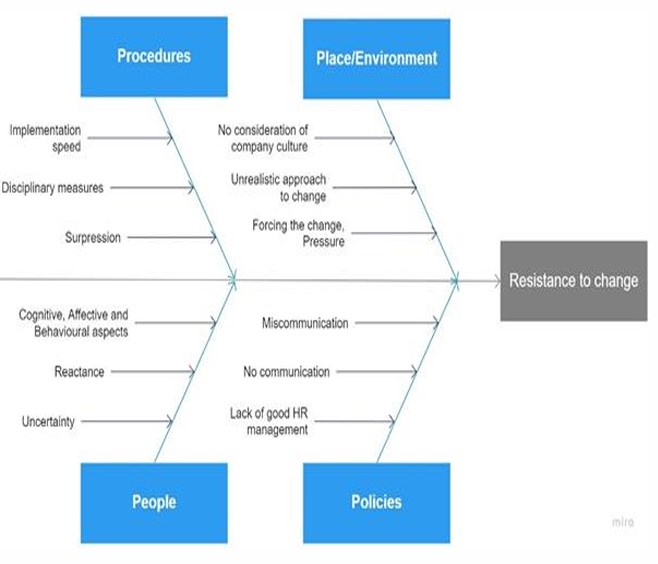
(source: Mary Dempsey et al, 2021)
The above diagram shows
"...The factors that influence resistance from the employees to change initiatives. Based on these aspects, action has been developed. In order to avoid resistance to change, change methods needed to be adapted to the organisation's culture. In addition, the change's merits and importance need to be communicated clearly, continuously, and directly to the affected employees. Planning the change systematically, involves the employees from the beginning and defining a realistic implementation schedule helps to reduce uncertainty and create readiness for change. However, if there is already resistance, it needs to be dealt with. Suppressing resistance or combating it with disciplinary measures will only reinforce the issue. Hence, it is critical to address any issues directly and develop good human resource practices. In conclusion, by creating readiness for change, the resistance of the employees towards change can be minimised..."
Mary Dempsey, 2021
- Standardised concept
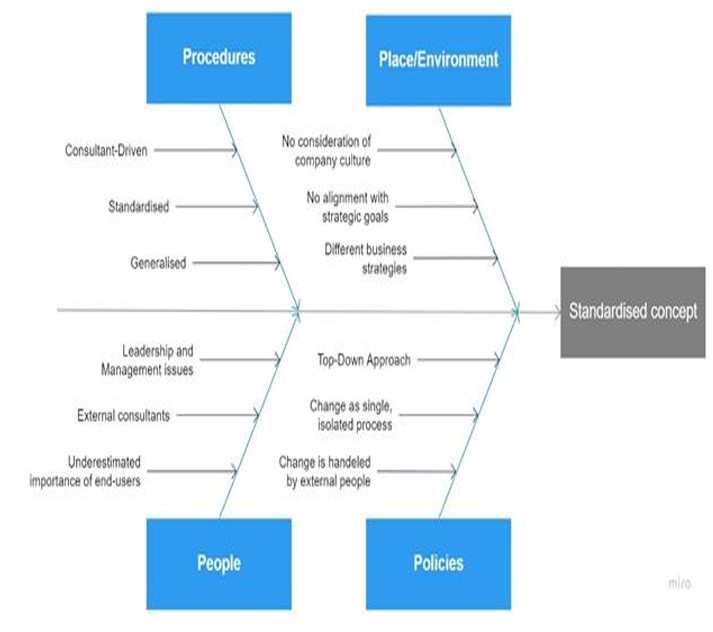
(source: Mary Dempsey et al, 2021)
The above diagram shows
"... There are several actions that can be identified quickly to resolve the problem of standardised concepts. Including external consultants can be helpful with their expertise in handling change, in addition to their neutrality and persuasiveness. However, they are only beneficial if they tailor their solutions individually to your organisation. Regardless of whether or not a change project is led by external consultants, it needs to be adapted to the organisation's culture and business environment as well as aligning the organisation's strategic goals and business strategies. In this manner, a customised approach can be developed that fits the organisation's needs. In addition, the leadership approach needs to focus on the role of leaders and managers of change and on a sustainable and quality enhancing employee participation. 'There is no universal theory of corporate change. However, a standardised format can give guidance when managing change. To be successful with a change initiative, it is important to adapt strategies and theories to the individual situation. If this is not the case, change initiatives will further fail..."
Mary Dempsey, 2021
3. Short-term View
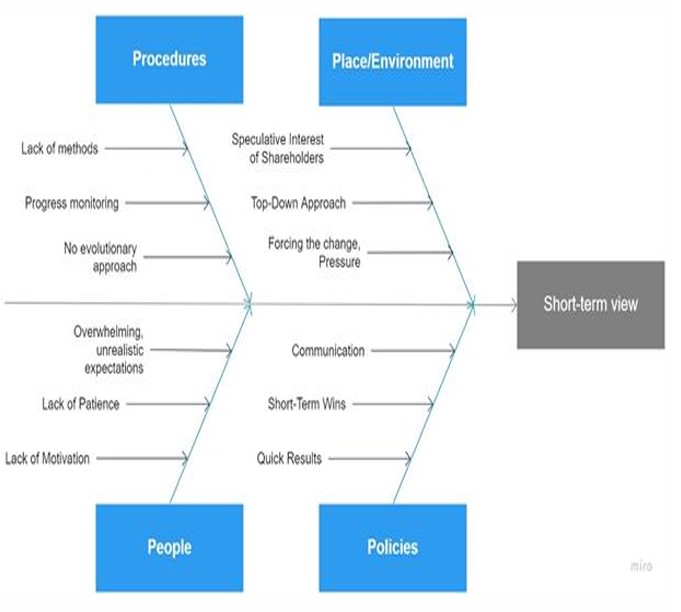
(source: Mary Dempsey et al, 2021)
The above diagram
"...not only covers the reasons for a short-term view but also has consequences and associated corrective actions. If top-management pressures its employees to implement a big change in a short amount of time, it can result in the employees being unmotivated and overwhelmed. Hence, it is essential to be patient and make the change a long-term project that includes an evolutionary process. However, long-term projects can also be demotivating. Therefore, it is helpful to plan and create short-term wins that show a rapid implementation success as they can help build momentum and support for the change. This can then motivate employees and facilitate the effort to expand inside the organisation. The setting of a clear and realistic timeframe can be beneficial in monitoring progress and supporting the taking of corrective action as soon as possible..."
Mary Dempsey, 2021